Burst Pipe? What to Do Right Now, Then Thaw Frozen Pipes Safely
A burst pipe needs the water off first: close the main shutoff valve if you can reach it without stepping into standing water, then open the cold faucets to drain the lines. Never walk through standing water to reach the breaker panel, and never touch a wet switch; call the power utility or an electrician. Then call a plumber. HomeAdvisor puts the repair at $200 to $3,000.

Water off, but not sure what failed? Describe it in the Fixable app and get a free diagnosis, no account needed.
In this article
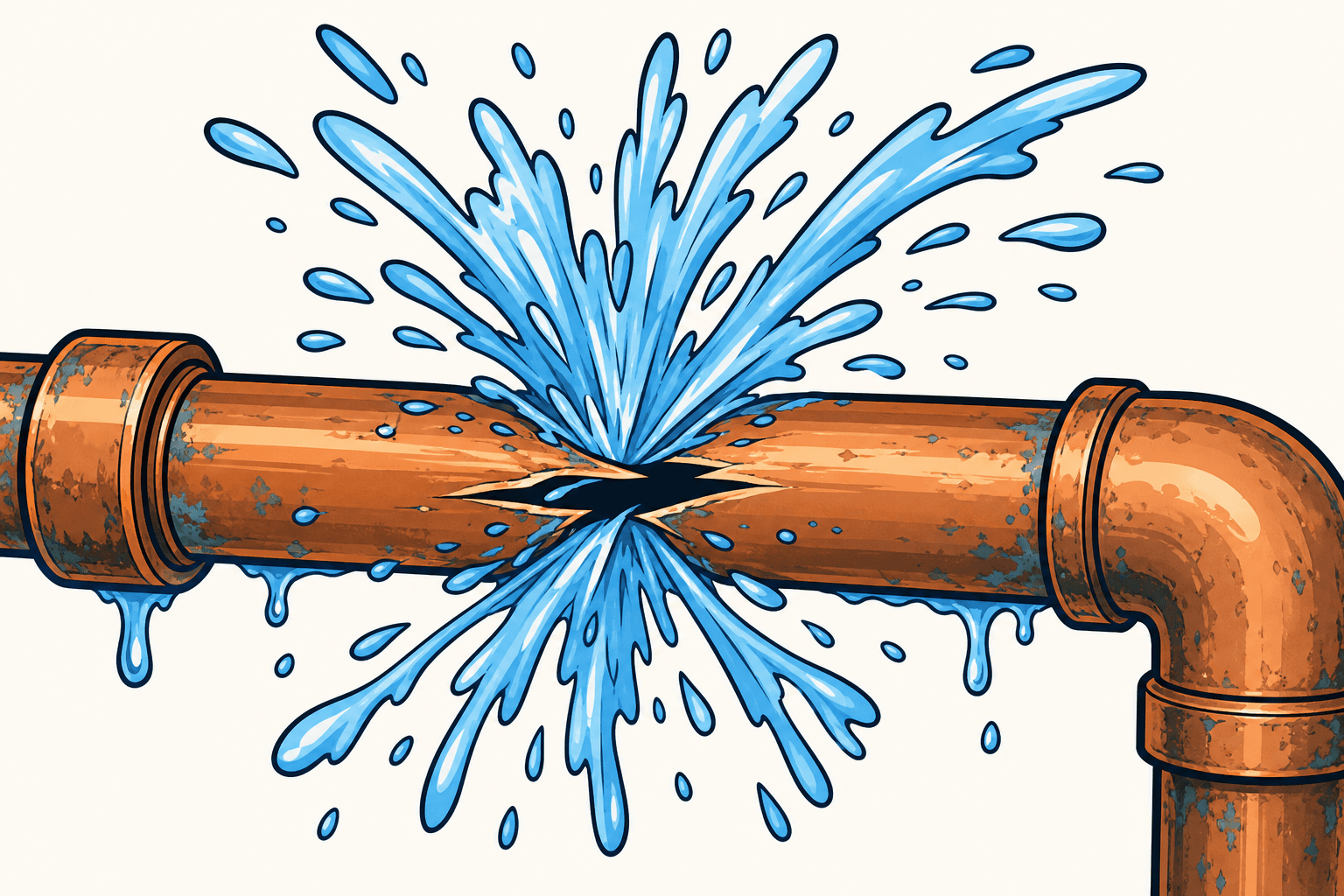
A burst pipe does not wait. Every minute the water runs, it soaks more floor, wall and ceiling. So the order matters: water off, stay clear of wet power, drain the lines, call a plumber. Those steps come first here, then safe thawing and prevention.
First, which problem do you have? Water spraying, a spreading stain or a dripping ceiling means a pipe has burst. Start with the first list. A tap that gives a trickle or nothing in a cold snap means a pipe is frozen and may not have split yet. Jump to the thawing section.
Burst Pipe: Do These Steps First, in This Order
Water and power do not mix
Never walk through standing water to reach the breaker panel, and never touch a wet switch, outlet or cord. Call the power utility or an electrician instead. If water runs through a ceiling light or into outlets, stay out of that room.
- 1Close the main shutoff valve, as long as you can reach it without stepping into standing water. It usually sits where the water line enters the house: basement, garage or utility closet. Turn a lever until it sits across the pipe, or a round wheel clockwise until it stops.
- 2If the valve is stuck, hidden or standing in water, do not force it and do not wade in. Call your water utility's emergency line and ask them to shut the water off at the street.
- 3Deal with power before you step into the wet area. If you can reach the breaker panel on a dry floor with dry hands, switch off the breakers for the wet rooms. If not: never walk through standing water to reach the breaker panel, and never touch a wet switch, outlet or cord. Call the power utility or an electrician.
- 4Open the cold faucets, starting with the lowest one in the house, and flush the toilets. That empties the pipes.
- 5Set buckets under drips. If a ceiling sags or bulges with water, stay out from under it.
- 6Call a plumber and say that the main is closed. Take photos of the pipe and the damage before you clean up, for your insurer.
Limit the Damage While You Wait
Once the water has stopped, dry the house fast. The EPA says to dry wet materials within 24 to 48 hours to keep mold from growing. Many home policies cover sudden water damage from a burst pipe, but an insurer may refuse a claim if the home was left unheated. Check yours and call early.
- 1Before you go in, check that the main shutoff valve is closed and the wet rooms are clear of live power, as in the first steps.
- 2Mop up the water, lay down towels and carry wet rugs and boxes out.
- 3Run fans or a dehumidifier only where the floor is dry and the outlets stayed dry.
- 4Keep receipts for anything you buy or rent to dry the house. If the water reached the basement, see water in the basement for the cleanup order.
A Temporary Patch Until the Plumber Comes
A patch is a stopgap for a small split in a pipe you can see and reach. It is not a repair. If you can manage without water until the plumber comes, leave the main closed. That is safer.
A patch is only for a small split in a water pipe
Do not cut or solder the pipe yourself, and do not patch anything on a gas line or at the water heater. That work belongs to the plumber. Keep away from a pipe near wet outlets or cords.
- 1Make sure the main shutoff valve is closed and the cold faucets are open, so the pipe is drained.
- 2Wipe the pipe dry. Fit a pipe repair clamp: lay its rubber pad over the split and tighten the screws evenly. No clamp? Wrap silicone repair tape tightly around the pipe, stretched and overlapped, well past both ends of the split.
- 3Close the faucets, then have someone watch the patch while you open the main valve slowly, part of the way. If it drips, close the main again and leave it closed.
Frozen Pipe: How to Thaw It Safely
A frozen pipe often shows no leak at all. The ice plugs the split, and the water comes when it melts. So look before you warm anything. The heat sources and the open faucet follow the American Red Cross.
No open flame, ever
Never use a blowtorch, a propane or kerosene heater or any other open flame to thaw a pipe. It can start a fire inside the wall. Use no electric device where water stands or the pipe already leaks. If the pipe is cracked, inside a wall or out of reach, call a plumber.
- 1Find the main shutoff valve first, so you can close it fast. Then look along the pipe. If you see a crack, a split, a bulge or any water, close the main and call a plumber. Do not thaw it.
- 2Open the faucet that the frozen pipe feeds and leave it open. Running water helps melt the ice.
- 3Find the frozen part. Look along outside walls, in the crawl space and under sinks for frost or a section that feels much colder.
- 4Check that the floor, the cord and your hands are dry. Then warm the pipe with a hair dryer, an electric heating pad wrapped around it, or towels soaked in hot water.
- 5Start at the faucet end and work back toward the frozen part, so the melted water can run out of the open tap.
- 6A portable space heater also works. Keep it away from anything that can burn and never leave it alone.
- 7Watch the pipe as it thaws. At the first drip, stop the heat: unplug the hair dryer, heating pad or space heater if the plug and your hands are dry. If they are wet, do not touch the device; step back and switch off its breaker if you can reach the panel on a dry floor. Then close the main shutoff valve and call a plumber.
- 8If no water shows, keep the heat on until full water pressure is back. Then try the other faucets; one frozen pipe often means more.
- 9If you cannot find the frozen part, cannot reach it, or it will not thaw, call a licensed plumber.
What Keeps Pipes From Freezing
Pipes freeze where cold air reaches them. The insurance research group IBHS sets its alert line at 20°F outside for unprotected pipes. A pipe in a draft can freeze in milder weather. Most of these habits come from the Red Cross.
- 1Slide foam pipe sleeves over exposed pipes in the attic, crawl space, basement and garage.
- 2On freezing nights, open the kitchen and bathroom cabinet doors so warm air reaches the pipes under the sinks.
- 3Let cold water drip from a faucet fed by exposed pipes.
- 4Keep the thermostat at the same setting day and night during a cold snap.
- 5Going away? Leave the heat on, set no lower than 55°F.
- 6Keep the garage door closed if water lines run through it.
- 7Seal the gaps where pipes and cables pass through outside walls.
Outdoor Spigot or Water Line Keeps Freezing?
An outdoor spigot that keeps freezing usually has a hose still on it or water left in the line. A water line that keeps freezing in one spot has a draft or missing insulation there.
- 1Before the first frost, take the hose off the spigot.
- 2Close the indoor valve that feeds the spigot, if your house has one.
- 3Open the outdoor spigot so the water left in the pipe can drain, and leave it open for the winter.
- 4Ask a plumber about a frost proof spigot. It shuts the water off inside the warm wall.
- 5For a line that freezes in the same place, add foam sleeves and seal the draft. If the water pipe keeps bursting there, have a plumber move or protect that run. Weak flow in mild weather has other causes, see low water pressure.
Tools You Will Need
- Pipe repair clamp - temporary patch for a small split
- Silicone repair tape - backup patch when no clamp fits
- Hair dryer or electric heating pad - safe heat for a frozen pipe
- Foam pipe sleeves - keep exposed pipes above freezing
Pro tip
Hang a bright tag on the main shutoff valve today and show everyone at home where it is.
When to Call a Plumber, and What It Costs
Stopping the water and thawing a pipe you can reach are yours. The repair is not. HomeAdvisor lists a flat fee of about $100 for a plumber to thaw frozen pipes, and $200 to $3,000 to repair a burst one. Fixr puts water damage repair at $1,200 to $5,000 on average, billed on top. Call a plumber when:
- 1A pipe has split, cracked or bulged, even if a patch holds.
- 2The frozen pipe is inside a wall, a ceiling or a floor, or you cannot find it.
- 3Your pipes won't thaw with gentle heat.
- 4The leak is near the water heater, a gas line or the electrical panel.
- 5The same pipe has frozen or burst before.
Fix it with AI
Describe what is happening and Fixable's AI finds the cause and gives you every step. Found a video for this? Paste the link and get the diagnosis, the tools and the parts, without scrubbing through the whole video.
Frequently asked questions
How much does it cost to fix a burst pipe?
HomeAdvisor puts a burst pipe repair at $200 to $3,000, depending on where the pipe runs and how much wall or floor has to be opened. Thawing a frozen pipe that has not split is a flat fee of about $100. Repairing the water damage is billed on top; Fixr lists $1,200 to $5,000 on average.
Can I fix a burst pipe myself?
Only the first steps: close the main shutoff valve if you can reach it dry, then drain the cold faucets. Never walk through standing water to reach the breaker panel, and never touch a wet switch; call the power utility or an electrician. A clamp is only a temporary patch for a small split in a water pipe, never on a gas line or at the water heater. A plumber does the repair.
My pipes won't thaw. What now?
If pipes won't thaw with a hair dryer, a heating pad or hot towels, the ice likely sits inside a wall or out of reach. Never use a blowtorch, a propane or kerosene heater or any other open flame, and use no electric device where water stands or the pipe leaks. If you see a crack, a bulge or any water, close the main shutoff valve and do not thaw it. Call a licensed plumber.
Why does the same water pipe keep freezing or bursting?
A water pipe that keeps freezing sits in cold air: on an outside wall, in a crawl space or a garage. The research group IBHS puts the alert line for unprotected pipes at 20°F outside. Foam pipe sleeves, sealed gaps and a cold drip on freezing nights help. If it keeps bursting, have a plumber move or protect that run.
STILL STUCK?
Describe what's broken and Fixable's AI finds the cause and gives you every step. Found a repair video? Paste the link. Or scan the type plate and Fixable answers from the manual, with the page.
Open it in your browser, free to tryFree trial · 6 languages · Cancel anytime
Keep Reading
Low Water Pressure in the House? 7 Causes, Easiest First
Low water pressure has a short list of causes, and the cheap ones come first: a clogged aerator, a valve left half closed, a tired pressure valve. Here is how to tell which one is yours.
No Hot Water in the House? 5 Causes, Easiest First
No hot water anywhere is usually power, gas or the pilot. Cold at one tap only is the faucet. Hot water that runs out fast is the tank. Here is how to tell which, and what you can safely check.
Water Heater Leaking? What to Shut Off First, Then 5 Causes
Water on the floor by the heater usually comes from a fitting, not the tank. Only one of the five causes means a new heater. Here is how to tell which one you have in 30 minutes.
Water in the Basement? Find the Source Before You Pay for Waterproofing
Before anyone sells you a waterproofing system, find out where the water comes from. Rain, a leaking appliance and plain condensation all leave water on a basement floor, and only one of them needs a contractor.