Low Water Pressure in the House? 7 Causes, Easiest First
Low water pressure at one faucet is usually a clogged aerator or showerhead; soak it in vinegar. If the whole house is weak, check that the main shutoff is fully open without forcing it, then test with a gauge on an outdoor faucet. A reading under about 40 psi points at the pressure reducing valve, a leak or the supply.

Different model, or still stuck? Describe it in Fixable and get every step for yours.
In this article
- 01Start With These 30-Second Checks
- 021. Clogged Faucet Aerator or Showerhead (One Fixture)
- 032. A Shutoff Valve That Is Not Fully Open
- 043. A Failing Pressure Reducing Valve
- 054. A Clogged Whole-House Filter or Water Softener
- 065. Weak Hot Water Only: Look at the Water Heater
- 076. A Hidden Leak
- 087. Old Pipes, a Well or Low Supply From the Street
- 09When to Call a Plumber
Low water pressure turns a shower into a drizzle and makes the washing machine take forever to fill. The good news is that the most common causes are cheap: a clogged aerator, a valve someone left half closed, or a worn pressure valve. This guide goes from the free checks to the jobs for a plumber.
Two questions narrow it down fast. Is it one faucet or the whole house? One fixture points at that fixture's aerator, showerhead or shutoff valve. Everything weak at once points at the main valve, the pressure reducing valve, a filter, a leak or the supply. And is it only the hot water? Then the cause sits at the water heater, see cause 5.
Start With These 30-Second Checks
- 1Open the cold tap at two or three fixtures, including an outdoor faucet. Weak at one and strong at the others means the problem is at that one fixture.
- 2Compare hot and cold at the same faucet. Weak hot with normal cold points at the water heater.
- 3Ask a neighbor whether their pressure dropped too, and check your water utility's website for street work or a main break. If the whole street is weak, the utility has to fix it.
- 4Think back: did anyone work on the plumbing, replace the water heater or shut the water off recently? A main valve that was not fully reopened is a common result.
- 5Look at the water meter while every tap is off. If the dial or the small leak indicator moves, water is going somewhere, see cause 6.
1. Clogged Faucet Aerator or Showerhead (One Fixture)
The aerator is the small screen screwed into the tip of the faucet, and a showerhead has its own screen at the inlet. Minerals and grit from the pipes collect there, especially right after work on the plumbing, and the flow drops at that one fixture.
- 1Close the sink stopper or lay a cloth over the drain so small parts cannot fall in. If a part drops into a garbage disposal, never reach in: switch the disposal off at its wall switch and unplug it or turn off its breaker, lift the part out with tongs, and restore power only after the tongs are out of the sink.
- 2Unscrew the aerator from the spout by hand. If it is stuck, wrap it in tape or a cloth and turn it gently with pliers so the finish does not scratch.
- 3Open the tap for a few seconds with the aerator off. A strong flow now means the aerator was the cause; a weak flow means the problem is further back, so go on to cause 2.
- 4Note the order of the screen, the insert and the washer as they come apart. Rinse them and brush off the grit with an old toothbrush.
- 5If there is white crust, soak the parts in white vinegar for an hour or so, rinse them, and screw the aerator back on hand tight.
- 6For a showerhead, unscrew it from the shower arm, soak it the same way and clean the screen at the inlet. If the flow is still weak with the head off, the valve behind the wall is the problem, which is plumber work.
2. A Shutoff Valve That Is Not Fully Open
Every sink and toilet has small shutoff valves on its supply lines, and the house has a main shutoff where the water line comes in. A valve left partly closed after a repair chokes the flow at one fixture or everywhere.
Never force an old valve
An old valve that will not turn, or that starts to drip at the stem, can break or leak once it is moved. Stop, turn it back to where it was, and call a plumber. A broken main valve leaves the house with no way to shut the water off.
- 1Under a kitchen sink, switch the garbage disposal off at its wall switch and unplug it or turn off its breaker before any hand goes into the cabinet.
- 2Find the two small valves on the supply lines under the sink or behind the toilet. Turn each handle counterclockwise gently until it stops.
- 3If a valve starts to drip at the stem when you turn it, turn it back a little and call a plumber.
- 4Find the main shutoff: usually where the water line enters the house, in the basement, the garage, a utility closet or near the water heater. A lever valve is fully open when the handle lines up with the pipe. A round wheel valve is open when it is turned counterclockwise until it stops.
- 5If the main valve is stiff or stuck, leave it as it is and call a plumber.
- 6Take your hands out from under the sink, then restore power to the disposal and open the tap to test.
3. A Failing Pressure Reducing Valve
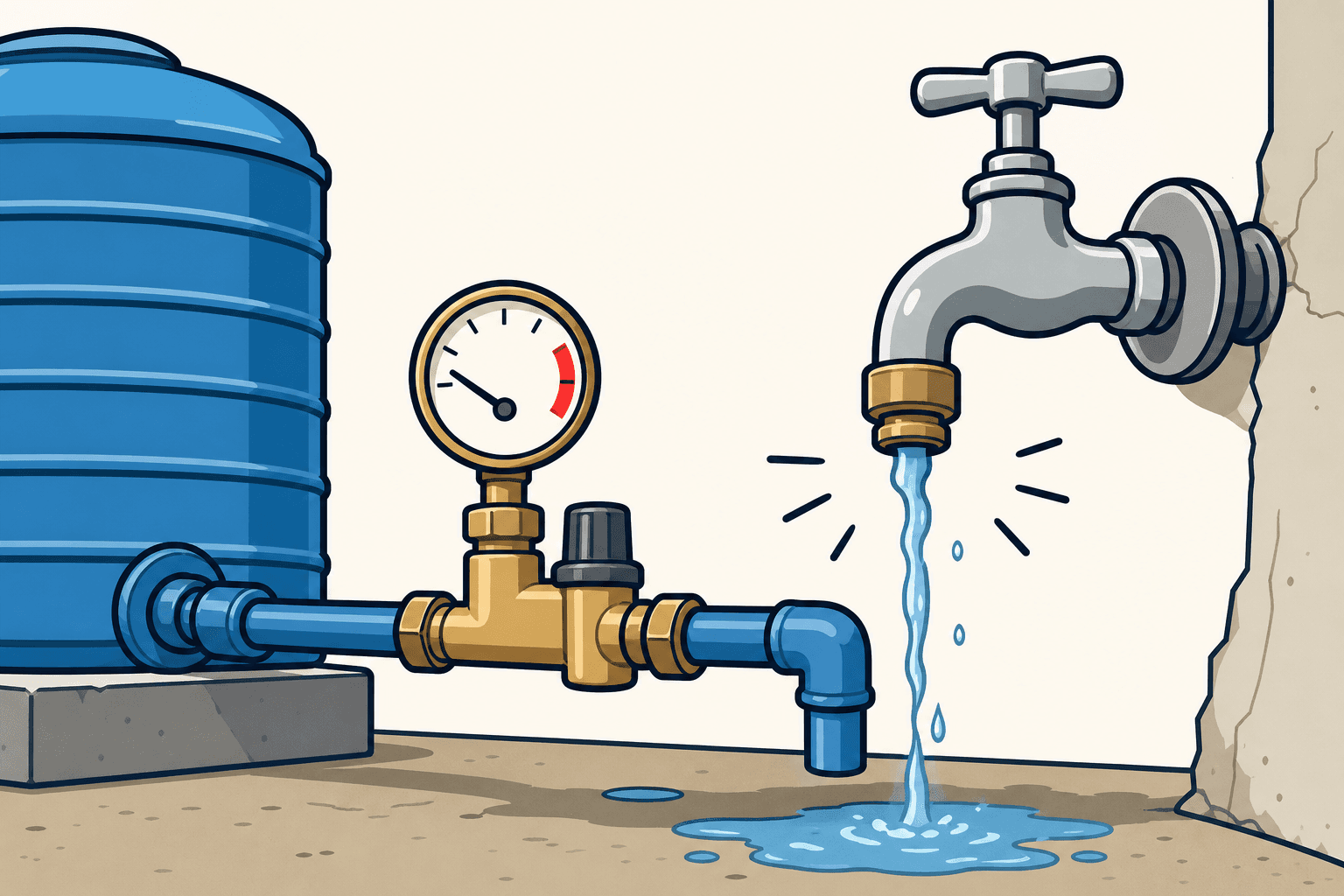
Many homes on city water have a pressure reducing valve, a bell shaped brass valve on the main line just after the main shutoff. It lowers high street pressure to a safe level, and when it wears out it can drop the pressure in the whole house. The International Plumbing Code requires one where the static pressure is above 80 psi, and around 40 to 80 psi is the range plumbers commonly treat as normal.
- 1Get a pressure gauge that screws onto a hose faucet. Home Depot lists basic ones from about $12.
- 2Turn off every tap inside, and make sure the washer, the dishwasher and any sprinklers are not running.
- 3Screw the gauge onto the outdoor faucet closest to where the main line comes in, open the faucet fully and read the dial. Some outdoor faucets branch off before the pressure reducing valve and show street pressure, so if the dial looks normal but the house is weak, test again at a laundry sink faucet with hose threads.
- 4Under about 40 psi is low. If your house has a pressure reducing valve, have a plumber check, adjust or replace it; HomeGuide puts a replacement at about $300 to $650.
- 5If there is no pressure reducing valve and the reading is low, the supply or the pipes are the limit, see cause 7.
- 6Over 80 psi is too high, not too low: have the valve checked too, because high pressure strains pipes, hoses and the water heater. Write the reading down either way; it tells the plumber or the utility where to start.
4. A Clogged Whole-House Filter or Water Softener
If your house has a whole-house filter or a water softener, every drop passes through it. A clogged cartridge or a softener problem slows the whole house, and the drop often builds over weeks rather than overnight.
- 1Find the bypass valve on the softener or the filter housing. On most softeners it is a knob or a pair of handles at the back, and the manual shows which position is bypass.
- 2Put the unit on bypass and open a cold tap. If the pressure comes back, the filter or the softener is the cause.
- 3To change a filter cartridge, close the valves on both sides of the housing, press the pressure release button if it has one, and set a bucket underneath before you unscrew the housing.
- 4Fit the new cartridge, check that the O-ring sits in its groove, screw the housing back on hand tight and open the valves slowly. Watch for drips for a few minutes.
- 5If the softener is the cause, check the salt and the settings in its manual, or call the company that services it.
5. Weak Hot Water Only: Look at the Water Heater
When the cold is strong and only the hot is weak, the restriction sits at or after the water heater: a partly closed valve on the cold inlet, sediment in an old tank, or on a tankless heater a clogged inlet filter. For a heater that gives no hot water at all, see no hot water.
- 1Find the valve on the cold water pipe that feeds the water heater and check that it is fully open. Do not touch the gas valve, the burner or anything electrical on the heater, and if you smell gas, leave the house and call the gas company from outside.
- 2Check the hot shutoff valves under the sinks the same way. At a kitchen sink, switch the disposal off at its wall switch and unplug it or turn off its breaker first.
- 3On a tankless heater, the manual shows an inlet water filter. Turn off the heater's power at the breaker and close its water valves as the manual describes before you take the filter out, then rinse it and refit it.
- 4Sediment in an old tank can choke the hot outlet. Flushing a tank means handling scalding water, so if you have never done it, have a plumber do it.
- 5If the hot side is weak at every fixture and the valves are open, have a plumber look at the heater and its fittings.
6. A Hidden Leak
Water that escapes through a broken pipe never reaches your faucets, so a leak can lower the pressure and raise the bill at the same time. The EPA's WaterSense program suggests a simple meter test.
- 1Turn off every tap and every appliance that uses water, and make sure nobody uses water during the test.
- 2Read the water meter and write the number down.
- 3Wait two hours without using any water, then read it again. If the number changed, water is leaking somewhere.
- 4Walk the house: look for damp spots on ceilings, walls and floors, soggy ground in the yard along the line from the meter, and water in the sink cabinets. For the cabinet under a sink, see leak under the sink.
- 5If you find water near outlets, cords or the electrical panel, keep away from it. Turn off the power at the breaker only if you can reach the panel standing on a dry floor, otherwise call an electrician.
- 6If you cannot find the leak, call a plumber. A leak in the line from the street or under a slab needs their equipment.
7. Old Pipes, a Well or Low Supply From the Street
If the gauge reads low, the valves are open, there is no leak and no filter in the way, the limit is the supply or the pipes themselves.
- 1Galvanized steel pipe, common in older homes, rusts and narrows from the inside over decades. A plumber can usually tell from the pipe near the main valve; the fix is new pipe, which is a quote job.
- 2On a well, low pressure often comes from the pressure tank or the pressure switch. Both sit on live electrical circuits, so have a well contractor check them rather than adjusting the switch yourself.
- 3On city water, call the utility with your gauge reading. They can tell you the usual pressure on your street and whether work is planned.
- 4If only the top floor of a tall house is weak, height alone costs pressure. A plumber can tell you whether a booster pump makes sense.
🛠️ Tools You Will Need
- •Hose faucet pressure gauge - one reading tells you whether the house or one fixture is the problem
- •White vinegar - dissolves the mineral crust in aerators and showerheads
- •Old toothbrush - cleans aerator screens without bending them
- •Pliers and tape or a cloth - for a stuck aerator, without scratching the finish
- •Bucket and towels - for changing a filter cartridge
Pro tip
Write the gauge reading and the date on a piece of tape on the main pipe. Next time the flow drops, one new reading tells you at once whether the whole house changed or only one fixture did.
When to Call a Plumber
The aerators, the valve check and the gauge are yours. These go to a plumber, or to a well contractor on a well:
- 1The gauge reads under 40 psi or over 80 psi.
- 2The main valve or a fixture valve is stuck, or drips when you turn it.
- 3The meter test shows a leak you cannot find.
- 4The pipes are galvanized and the pressure has dropped slowly over the years.
- 5Anything on a well pump, a pressure tank or a pressure switch.
Fix it with AI
Describe what is happening and Fixable's AI finds the cause and gives you every step. Found a video for this? Paste the link and get the diagnosis, the tools and the parts, without scrubbing through the whole video.
Frequently asked questions
How much does it cost to fix low water pressure?
Often nothing: a clogged aerator or a half closed valve costs only time, and Home Depot lists a basic hose faucet pressure gauge from about $12. If the pressure reducing valve has failed, HomeGuide puts a plumber's replacement at about $300 to $650. Replacing corroded galvanized pipe is a much bigger job, so get two quotes.
Can I fix low water pressure myself?
Yes for the common causes: cleaning an aerator or showerhead, opening a shutoff valve fully, putting a filter or softener on bypass and testing with a gauge. Leave a failed pressure reducing valve, a stuck or dripping valve, new pipe and any well pump or pressure switch work to a plumber or a well contractor.
Why did my water pressure suddenly drop in the whole house?
A sudden drop everywhere usually comes from outside the fixtures: street work by the utility, a main valve someone did not fully reopen, a failing pressure reducing valve or a burst pipe. Ask a neighbor first. If their pressure is fine, check that your main valve is fully open without forcing it, and run the two hour meter test for a leak.
Will the pressure drop again after I clean the aerator?
In a hard water area, yes, slowly. Minerals build up in aerators and showerheads again over months, so soak them in vinegar whenever the flow weakens. If one faucet clogs again within weeks, loose grit from old pipes or recent plumbing work is the likely source, and a plumber can flush the line.
STILL STUCK?
Describe what's broken and Fixable's AI finds the cause and gives you every step. Found a repair video? Paste the link. Or scan the type plate and Fixable answers from the manual, with the page.
Open it in your browser, free to try →Free trial · 6 languages · Cancel anytime
Keep Reading
Drain Flies? What Causes Them and How to Get Rid of Them
Drain flies are not a pest problem, they are a drain problem. They breed in the slimy film inside the pipe, and the fix is a brush, not a spray. Here is how to find the drain and clean it out.
No Hot Water in the House? 5 Causes, Easiest First
No hot water anywhere is usually power, gas or the pilot. Cold at one tap only is the faucet. Hot water that runs out fast is the tank. Here is how to tell which, and what you can safely check.