Leak Under the Sink? How to Find It and Stop It
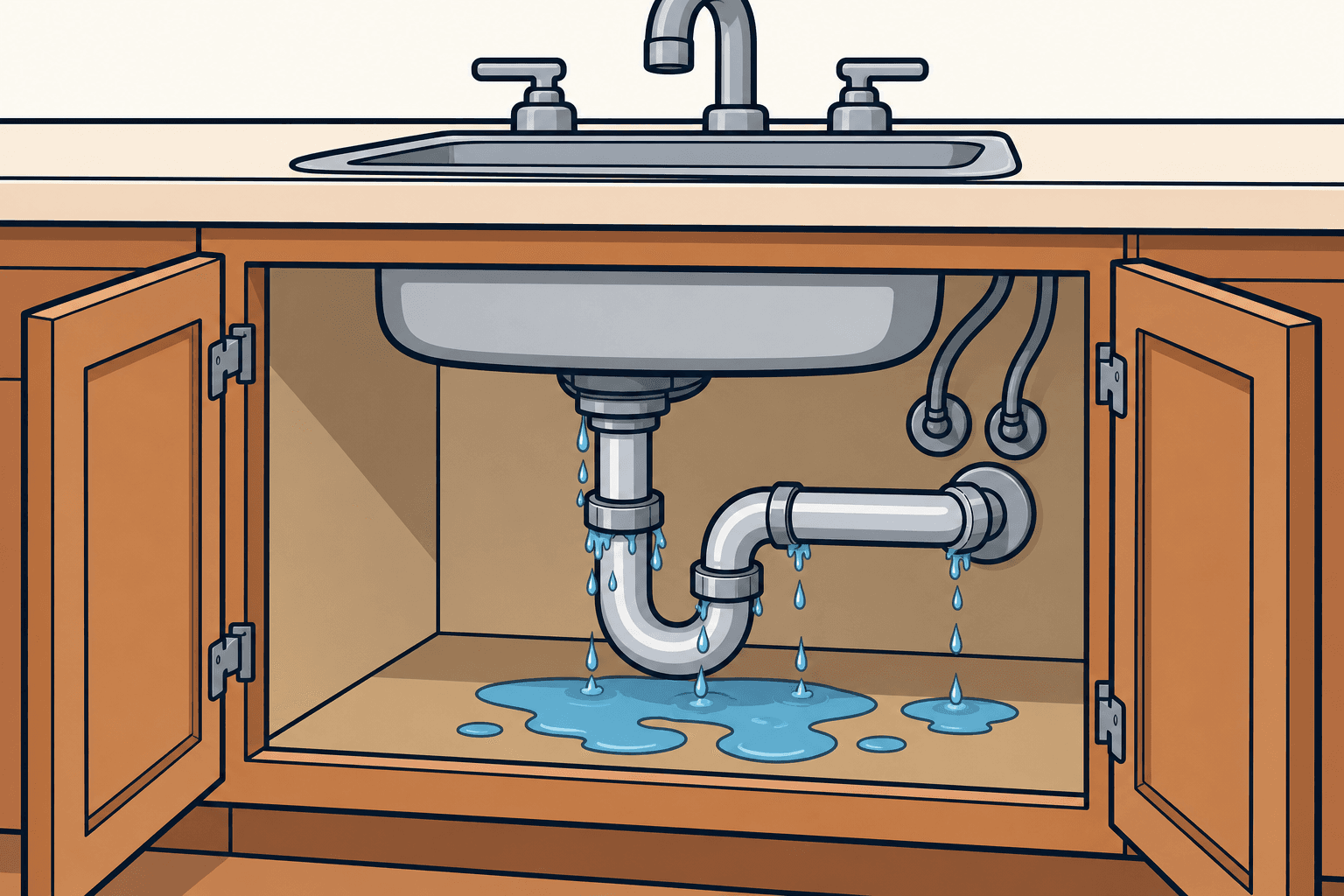
A leak under the sink is usually a loose P-trap nut or a worn washer. First switch off any disposal and unplug it or turn off its breaker. Run water and wipe each joint with a paper towel. Tighten the wet nut by hand plus a quarter turn, or replace its washer. A trap kit costs about $15 to $26.

Different model, or still stuck? Describe it in Fixable and get every step for yours.
In this article
A leak under the sink shows up as a wet cabinet floor, a swollen shelf or a bowl that keeps filling. It usually means one joint is letting water out. Most of these joints are held by nuts you can turn by hand and rubber washers you can replace, so you can usually fix it without a plumber.
The first question splits the problem: does it leak only while water runs down the drain, or all the time? A drip only when the drain is in use points to the trap, the strainer or a drain hose. A drip even when nothing runs points to the supply lines or the shutoff valves, which are always under pressure.
Start With These Quick Checks
Disposal off before your hands go near it
If a garbage disposal sits under the sink, switch it off at the wall switch and also unplug it or turn off its breaker before you reach in. Keep a bucket under any joint you open: a trap holds a cup or two of dirty water.
- 1If a garbage disposal sits under the sink, switch it off at the wall and also unplug it or turn off its breaker. Then empty the cabinet, dry every pipe and joint with a towel, and lay a dry paper towel on the cabinet floor.
- 2Wait ten minutes without running any water. Drops on the paper now come from the supply side: the hoses to the faucet or the shutoff valves.
- 3Then fill the sink a few inches with the stopper in and let it all drain at once. Wipe each drain joint with a dry paper towel: the trap nuts, the strainer under the sink and any dishwasher hose.
- 4Run the faucet and look at its base on top of the sink. Water running down the outside of the hoses from above means the faucet itself leaks.
1. A Loose or Worn P-Trap
The P-trap is the U-shaped bend under the drain. Plastic traps are held together by slip nuts with a beveled washer inside each one. A nut that has worked loose, or a washer that has gone hard, lets water out every time the sink drains.
- 1If a disposal is under this sink, switch it off at the wall switch and unplug it or turn off its breaker. Put a bucket under the trap.
- 2Tighten each slip nut by hand, then a quarter turn more. Plastic nuts crack if you force them with pliers.
- 3Fill the sink, let it drain and wipe the joints again. If a joint still weeps, unscrew that nut, empty the trap into the bucket and look at the washer.
- 4Fit a new washer with its beveled side facing the joint, line the pipes up straight and screw the nut back on by hand.
- 5Replace a cracked trap, or a metal one eaten through by rust. This Old House puts a new PVC trap at $15 to $20 in material; a universal kit costs around $26.
2. A Leaking Sink Strainer
The strainer is the metal basket in the sink's drain hole, sealed with plumber's putty and held from below by a big locknut. When the putty dries out, water seeps around it and runs down the outside of the drain pipe. Sinks with a disposal have a flange instead, see garbage disposal leaking.
- 1If a disposal sits under the other bowl, switch it off and unplug it or turn off its breaker. Put a bucket under the drain and unscrew the slip nut that joins the trap's tailpiece to the strainer.
- 2Hold the strainer still from above while a helper loosens the big locknut underneath with large slip joint pliers.
- 3Lift the strainer out, scrape off all the old putty and clean both surfaces.
- 4Roll a rope of plumber's putty about as thick as a pencil, press it under the strainer's lip and set it in the hole. On stone sinks use silicone instead, because putty can stain stone.
- 5From below, fit the rubber gasket and the paper washer in the order your strainer's diagram shows, then tighten the locknut until the putty squeezes out evenly. Wipe the excess away, reconnect the tailpiece and test with a full sink.
3. A Dripping Supply Line or Shutoff Valve
The two hoses from the shutoff valves to the faucet are under full water pressure all the time. A drip here does not wait for you to use the sink.
- 1If a disposal sits under the sink, switch it off and unplug it or turn off its breaker. Close both shutoff valves by turning them clockwise, then open the faucet to let the pressure out. Keep a bucket ready.
- 2If the drip is at a hose nut, tighten it a quarter turn with a wrench while you hold the valve still with a second wrench.
- 3If the hose is wet along its length, bulging or rusty, replace it with a new braided supply line of the same length and fittings.
- 4If the drip comes from behind the valve's handle, tighten the small packing nut on the valve by an eighth of a turn.
- 5Open the valves slowly and watch for a minute. A valve that will not close fully, or drips from its body, should be replaced by a plumber.
4. The Faucet Leaking From Above
If the hoses are dry at the valves but wet higher up, the water comes from the faucet. It runs down the outside of the hoses or the faucet body and drips into the cabinet.
- 1Run the faucet and watch its base on top of the sink. Water pooling there means a worn seal inside the faucet.
- 2If you have a pull-out sprayer, pull the hose out and look for a split. Before you reach under the sink to check its connector, switch off any disposal and unplug it or turn off its breaker.
- 3Look at the caulk along the sink's rim and around the faucet: splashes that get under a failed bead can drip down inside the cabinet.
- 4Worn faucet seals are the same repair as a dripping faucet, see how to fix a leaking faucet.
5. The Dishwasher Drain Hose
In a kitchen, the dishwasher's drain hose joins the disposal or a branch on the drain under the sink. A loose clamp leaks only while the dishwasher pumps out.
- 1Start a short dishwasher cycle and watch the hose connection under the sink with a flashlight while it drains. Keep your hands out.
- 2Before you touch the clamp, unplug the dishwasher or turn off its breaker, and switch the disposal off at its wall switch and at its plug or breaker.
- 3Tighten the clamp, or cut off a cracked hose end and refit it with a new clamp.
- 4Turn the power back on with your hands clear and run another cycle to check.
🛠️ Tools You Will Need
- •Bucket and paper towels - Catching trap water and finding the wet joint
- •Flashlight - Seeing the back of the cabinet
- •Large slip joint pliers - Strainer locknut and stubborn metal nuts
- •Two adjustable wrenches - Supply line nuts without twisting the valve
- •Slip joint washers - The usual cause of a weeping trap
- •Plumber's putty - Resealing a sink strainer
Pro tip
Leave a dry paper towel on the cabinet floor for a week after the repair. A small brown spot tells you about a slow drip long before the shelf swells again.
When to Call a Plumber
HomeAdvisor puts a plumber's drain pipe repair under the sink at $100 to $500. It is worth it in these cases:
- 1Water comes from a pipe inside the wall, or from a pinhole in a copper pipe.
- 2A shutoff valve will not close, or leaks from its body.
- 3The leak comes back within days after you replaced the washers and tightened the nuts.
- 4The cabinet floor is soft or moldy: the leak may have run for months, and the floor below may be wet too.
Fix it with AI
Describe what is happening and Fixable's AI finds the cause and gives you every step. Found a video for this? Paste the link and get the diagnosis, the tools and the parts, without scrubbing through the whole video.
Frequently asked questions
How much does it cost to fix a leak under the sink?
Tightening a nut or swapping a washer costs nothing or a few dollars. This Old House puts a new PVC trap at $15 to $20 in material, and a universal kit costs around $26. HomeAdvisor puts a plumber's drain pipe repair at $100 to $500, depending on what has to be replaced.
Can I fix a leaking P-trap myself?
Yes. If a garbage disposal sits under the sink, first switch it off at the wall and unplug it or turn off its breaker. Then put a bucket under the trap, unscrew the slip nuts by hand, check the washers and the pipe, and screw it back together hand tight plus a quarter turn.
Why does the sink only leak when I run the dishwasher?
Then the water comes from the dishwasher's drain hose where it joins the disposal or the drain, usually a loose clamp or a cracked hose end. Watch the joint with a flashlight while the dishwasher drains. Before you tighten anything, unplug both machines or turn off their breakers, and switch the disposal off too.
Will the cabinet floor dry out on its own?
Light dampness does, once the leak is fixed and the doors stay open with a fan for a day or two. Particleboard that has swollen or turned soft stays damaged and can grow mold underneath, so cut it out and replace it once the cabinet is completely dry.
STILL STUCK?
Describe what's broken and Fixable's AI finds the cause and gives you every step. Found a repair video? Paste the link. Or scan the type plate and Fixable answers from the manual, with the page.
Open it in your browser, free to try →Free trial · 6 languages · Cancel anytime
Keep Reading
No Hot Water in the House? 5 Causes, Easiest First
No hot water anywhere is usually power, gas or the pilot. Cold at one tap only is the faucet. Hot water that runs out fast is the tank. Here is how to tell which, and what you can safely check.
Mold in Shower Caulk? How to Get It Out and Keep It Away
Black spots in shower caulk are mold, and whether you can scrub them off depends on one thing: are they on the surface or inside the silicone? Here is how to tell, and how to stop them coming back.