Air Conditioner Noise: What Each Sound Means and When to Switch It Off
Air conditioner noise is normal when it is a steady hum or a single click as it starts and stops. Rattling usually means debris or a loose panel, whistling a clogged filter, squealing worn fan bearings. Loud buzzing with the fan still, hissing, screaming or banging: set the thermostat to Off, switch off its breaker and call a technician. If you smell gas, switch nothing and leave the house.

Can't tell which sound yours is making? Describe it in the Fixable app and get a free diagnosis, no account needed.
In this article
- 01Start With These 30-Second Checks
- 02What Each Air Conditioner Noise Means
- 031. Rattling: Debris or a Loose Panel
- 042. Whistling: A Clogged Filter or Closed Vents
- 053. Loud Buzzing Outside, Fan Not Turning
- 064. Squealing or Screeching
- 075. Hissing, Bubbling or Screaming: Switch It Off
- 086. Heat Pump Noises in Winter
- 09When to Call an HVAC Technician
Air conditioner noise is not always a problem. A steady hum from the outdoor unit and a soft rush of air at the vents are what a working system sounds like. A new sound that was not there last week is different: usually a part has come loose, a fan is starting to fail, or something has got into the unit. The kind of sound and where it comes from tell you which, and a few of them mean switch it off now.
Answer two questions first. Does the sound come from the outdoor unit or from inside, at the indoor cabinet or the vents? And does it still cool normally? A noise with normal cooling can usually wait for a booked visit. A noise with warm air, a burning smell or a tripped breaker cannot.
Switch it off before you look closer
Set the thermostat to Off first. Before you touch anything at the outdoor unit, also switch off the AC's breaker, or switch off or pull out the disconnect next to it. Never open the unit's electrical panel: the capacitor inside can hold a dangerous charge even with the power off. If you smell gas or rotten eggs near a gas furnace, do not switch anything: leave the house and call the gas company from outside.
Start With These 30-Second Checks
- 1Stand next to the outdoor unit while it runs and listen without touching it. Note whether the sound comes from the top, where the fan is, from the middle, where the compressor sits, or from a side panel.
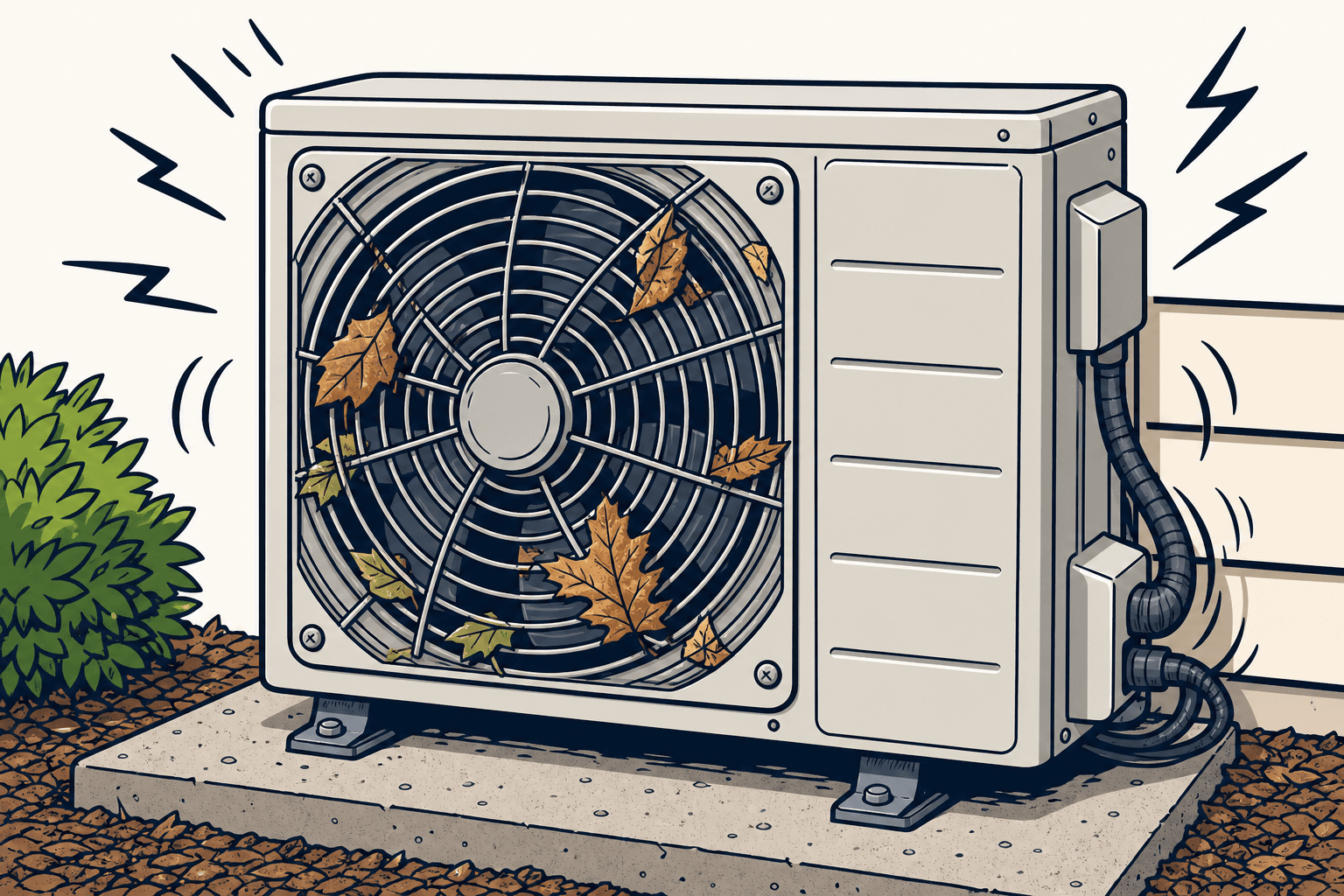
- 2From a step back, look at the top grille without reaching in or leaning over it. Leaves, sticks or a toy touching the blades make a rattle or a slapping sound.
- 3Check the breaker panel. A tripped AC breaker together with a loud buzz or a burning smell means leave it off and call a technician.
- 4Go inside and listen at the vents and the indoor cabinet. A rattle or a whistle there is usually a loose vent cover or a clogged filter, not the outdoor unit.
- 5Set the thermostat to Off, then pull the air filter and hold it up to a light. If you cannot see light through it, it is clogged.
What Each Air Conditioner Noise Means
- Steady hum, and one click as it starts and stops: normal, the compressor, the fans and the relay switching.
- Rattling: something loose, debris in the fan, a loose panel screw outside, or a loose vent cover inside. Fix 1.
- Whistling at the vents or the indoor unit: a clogged filter or blocked vents starving the system of air. Fix 2.
- Loud buzzing outside with the fan not turning: often a failed capacitor or a failing contactor. Fix 3.
- Squealing or screeching: worn fan motor bearings outside, or the blower motor inside. Fix 4.
- Hissing, bubbling or screaming: the refrigerant circuit. Fix 5, and switch it off.
- Banging or clanking: a loose or broken part, or a fan blade hitting something. Switch it off and call a technician.
- Dripping or gurgling inside: the condensate drain, see AC dripping water inside.
- A whoosh and steam from the outdoor unit in winter: a heat pump defrosting, which is normal. Fix 6.
1. Rattling: Debris or a Loose Panel
Most rattles from the outdoor unit are leaves or twigs touching the fan, or a cabinet screw that has worked loose from years of vibration. Both are owner jobs as long as the power is off.
- 1Set the thermostat to Off, then switch off the AC's breaker, or switch off or pull out the disconnect next to the outdoor unit.
- 2Wait until the fan has stopped completely. Clear leaves, grass clippings and sticks from around the unit and keep about two feet of open space on every side.
- 3Look through the grille for debris on the blades. Do not take the top grille off: on most units the fan motor and its wiring hang from it. If something is stuck inside, leave it for the technician.
- 4Tighten loose screws on the outer cabinet panels with a nut driver. Leave the electrical access panel closed.
- 5Inside, tighten or reseat any vent cover that buzzes or rattles.
- 6Switch the disconnect back on and the breaker back on with your hands clear of the unit, set the thermostat to Cool and listen again.
2. Whistling: A Clogged Filter or Closed Vents
A filter packed with dust makes the blower pull air through a gap that is too small, and that whistles. It also costs cooling and can let the indoor coil ice up. Lennox advises changing a standard one-inch filter every three months, and about once a month with pets or allergies.
- 1Set the thermostat to Off.
- 2Slide the filter out of the return grille or the filter slot at the indoor unit and read the size printed on its frame.
- 3Fit a new filter of the same size, with the arrow on its frame pointing toward the indoor unit, in the direction the air flows.
- 4Open closed supply vents, and move furniture or rugs off any return grille.
- 5With the filter in and the grille closed, keep your hands clear, set the thermostat back to Cool and listen at the indoor unit.
3. Loud Buzzing Outside, Fan Not Turning
A loud buzz with the outdoor fan standing still often means the capacitor that helps the motors start has failed, or the contactor that switches them is failing. Both sit behind the electrical panel, and the capacitor can hold a charge after the power is off, so this is a technician's repair. This Old House puts a capacitor replacement at about $80 to $400.
- 1Set the thermostat to Off and switch off the AC's breaker, so the motors stop straining and overheating.
- 2Do not push a stick through the grille to spin the fan, a common tip online: the blades can start suddenly, and you are working next to live parts.
- 3Write down what you heard before you switched it off: a buzz only at start-up, all the time, or with the fan still. That saves the technician time.
- 4Book an HVAC technician and tell them the fan does not turn while it buzzes.
4. Squealing or Screeching
A squeal that starts with the fan usually means worn motor bearings: the condenser fan outside, or the blower motor in the indoor cabinet. On older systems the indoor blower may run on a belt that slips and squeals. HomeAdvisor puts a condenser fan motor replacement at about $450 on average.
- 1While it runs, listen from a step away to tell where the squeal comes from: outside at the fan, or inside at the indoor cabinet. With a metal on metal screech, skip this and go straight to step 2.
- 2Set the thermostat to Off and switch off the AC's breaker, before the motor burns out.
- 3Leave the motor and the belt alone. Oiling or changing them means opening the unit next to its electrical parts.
- 4Book a technician. In a system where the furnace and the AC share the indoor blower, a failing blower affects the heat too.
5. Hissing, Bubbling or Screaming: Switch It Off
These sounds point at the refrigerant circuit: a leak, or pressure far too high inside the compressor. Trane says hissing is not a normal sound. Refrigerant work needs a technician certified by the EPA, and a leak usually means the system will stop cooling soon anyway.
- 1If the hiss is near a gas furnace and you smell gas or rotten eggs, do not switch anything on or off: leave the house and call the gas company from outside.
- 2Otherwise set the thermostat to Off and switch off the AC's breaker.
- 3Do not touch the copper lines or try to tighten fittings on them.
- 4Call a licensed HVAC technician and describe the sound and where it came from.
6. Heat Pump Noises in Winter
A heat pump is an air conditioner that also runs in reverse to heat. In cold, damp weather it melts the frost off its outdoor coil every so often: the fan stops, you hear a whoosh as it switches over, and a cloud of steam rises for a few minutes before the fan starts again. Trane calls this defrost cycle a normal process, and steam is not smoke. A unit that stays coated in solid ice for hours, grinds or squeals needs a technician.
Tools You Will Need
- Nut driver or screwdriver - Tightens loose screws on the outer cabinet panels.
- Flashlight - Shows debris on the fan blades through the grille.
- Replacement air filter - Same size as the one printed on the old filter's frame.
- Phone - Record the sound for the technician.
Pro tip
Record 20 seconds of the sound with your phone, standing next to the unit, before you call. A technician can often tell from the recording which part to bring.
When to Call an HVAC Technician
Book a technician if any of these apply. Fixr puts the most common AC repairs at roughly $150 to $650.
- 1It buzzes loudly and the outdoor fan does not turn.
- 2You hear hissing, bubbling, screaming or metal on metal screeching. Switch it off at the thermostat and the breaker first, unless you smell gas: then switch nothing and leave the house.
- 3The breaker trips again after you reset it once, or you smell burning. Leave the breaker off.
- 4The noise comes with warm air from the vents, see AC not cooling.
- 5A rattle stays after the debris is cleared and the outer panel screws are tight.
Fix your air conditioner with AI
Describe what your air conditioner is doing and Fixable's AI finds the cause and gives you every step. Or scan its type plate: Fixable finds the operating manual and answers from it, error codes included. Found a repair video for this? Paste the link and get the steps, tools and parts.
Frequently asked questions
How much does it cost to fix a noisy air conditioner?
A new filter or a tightened panel screw costs a few dollars. This Old House puts a capacitor replacement, a common cause of a loud buzz, at about $80 to $400, and HomeAdvisor puts a condenser fan motor replacement at about $450 on average. Fixr puts the most common AC repairs at roughly $150 to $650.
Can I fix a noisy AC myself?
Some of it. Changing the filter, clearing debris around the outdoor unit and tightening loose screws on the outer cabinet are owner jobs, with the thermostat set to Off and the breaker or the disconnect off. Capacitors, motors, contactors and refrigerant are technician work: a capacitor can hold a charge after the power is off, and refrigerant needs a certified technician.
Is it safe to keep running an AC that makes a noise?
A rattling vent cover or a whistling filter can wait a day. Hissing, screaming, a metal on metal screech, a burning smell or a loud buzz with the fan standing still cannot: running it can ruin the compressor or the motor. Set the thermostat to Off, switch off the AC's breaker and call an HVAC technician. If you smell gas, switch nothing: leave and call the gas company from outside.
Is a heat pump supposed to make noise in winter?
Yes, some. In cold weather a heat pump melts the frost off its outdoor coil every so often: the fan stops, you hear a whoosh as it switches over, and steam rises for a few minutes. Trane calls that a normal process. A unit that stays coated in solid ice, or grinds and squeals, needs a technician.
STILL STUCK?
Describe what's broken and Fixable's AI finds the cause and gives you every step. Found a repair video? Paste the link. Or scan the type plate and Fixable answers from the manual, with the page.
Open it in your browser, free to tryFree trial · 6 languages · Cancel anytime
Keep Reading
Refrigerator Making Noise? What Each Sound Means
Fridges hum, click, gurgle and pop on a normal day. The sounds worth checking are rattling, grinding, squealing, a loud buzz and a click that repeats while the fridge gets warm.
Washing Machine Making Loud Noise? 6 Causes (And Which Are Serious)
A washing machine should hum, not roar. The noise it makes is the single best clue to what is wrong - here is how to translate the sound into a diagnosis.
AC Dripping Water Inside the House? 5 Causes (Stop the Leak Today)
Water dripping from your AC into the house is a clear warning. Five causes cover most cases, and you can fix several of them yourself in under 30 minutes. Here is which is which.
AC Not Cooling Your House? 5 Fixes Before You Call HVAC
When the AC runs but the house stays warm, the cause is often a setting, a clogged filter or ice on the coil. Check those before you pay for a service call.