Washing Machine Making Loud Noise? 6 Causes (And Which Are Serious)
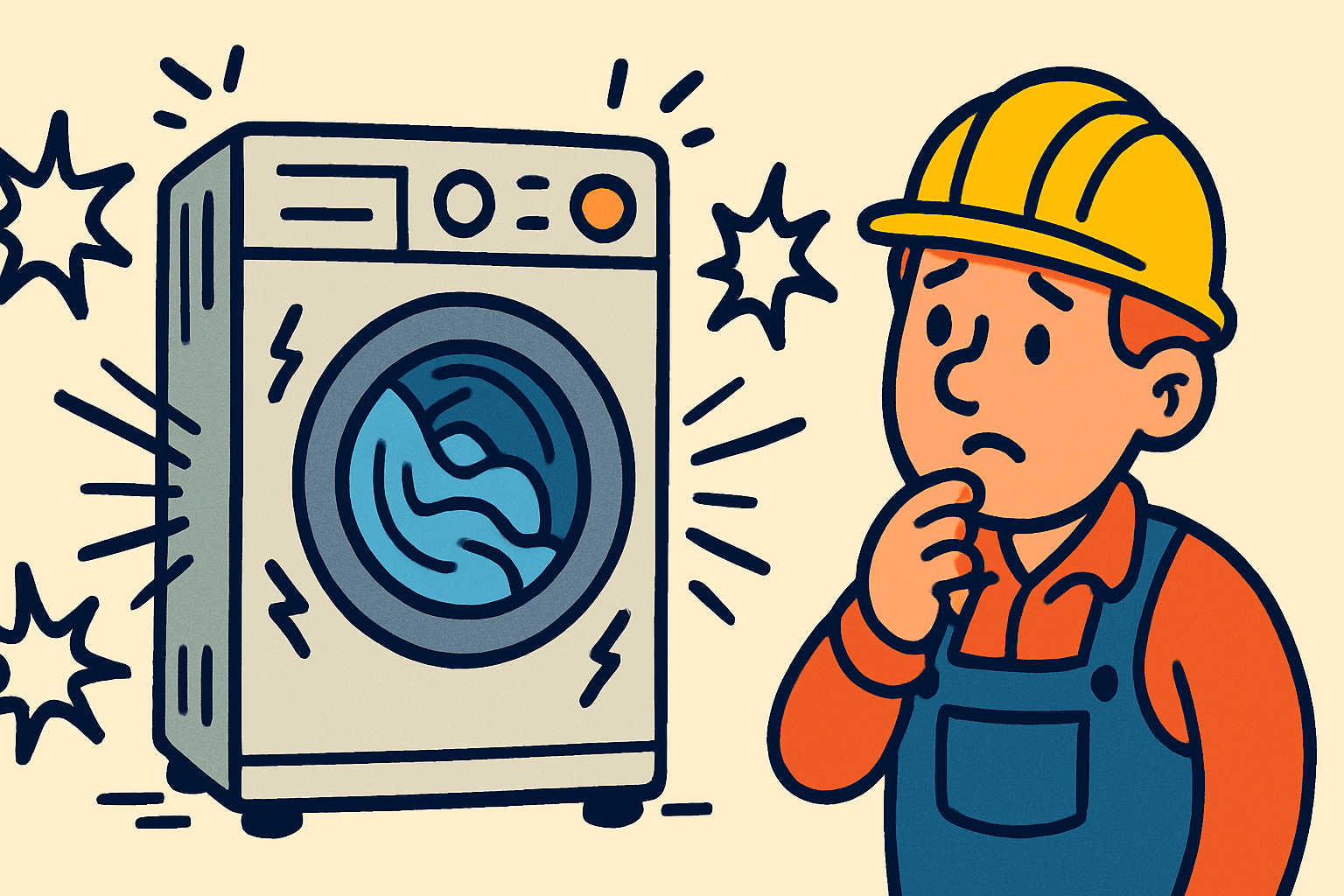
Most washing machine noise is an unbalanced load banging during spin. Pause the cycle, spread the wet laundry evenly around the drum, and restart, which takes about two minutes. If the noise repeats on every load, check the leveling feet, then the drain pump for coins. A steady roar that worsens weekly means drum bearings.
In this article
- 011. Loud Banging During Spin (Probably Just an Unbalanced Load)
- 022. Vibrating or Walking Across the Floor
- 033. Grinding or Rattling at Random Moments
- 044. Buzzing or Humming During the Drain Phase
- 055. High-Pitched Squeal That Gets Louder Over Time
- 066. Loud Rumbling or Roaring During Spin (Drum Bearings)
- 07Tools That Cover Most Repairs
- 08How to Prevent the Next One
- 09Quick Summary
Washing machines are surprisingly diagnosable by ear. A quiet hum during fill, a steady whoosh during wash, a faster whoosh during rinse, a louder whir during spin. When something changes - a clunk, a squeal, a grinding rumble - that change is information. Most repair guides skip this part, but the noise type narrows the cause to two or three suspects in seconds.
Here are the six most common noise types from least to most expensive to fix. If yours sounds like the bottom of this list, you have to make a decision about whether the repair is worth it on a 10-year-old machine.
1. Loud Banging During Spin (Probably Just an Unbalanced Load)
If the noise only happens during the spin cycle, especially with bedding or towels, the load is bunched up to one side. Pause the machine, redistribute the load, and restart. Modern machines try to rebalance automatically by stopping and restarting the spin a few times. Old machines will dance across the laundry room floor.
If banging happens with every load no matter how balanced, the suspension rods are worn (front-load) or the snubber pad is gone (top-load). Both are 20 dollar parts and a 30-minute job.
Quick check
Press down on each corner of the machine. If one corner sinks more than the others, you have found a worn suspension rod or shock absorber.
2. Vibrating or Walking Across the Floor
Almost always a leveling problem. Adjust the four feet so the machine sits dead level and does not rock when you push on opposite corners. The leveling feet have a lock nut - tighten that after adjusting or they will work themselves loose again. If the floor itself is uneven (older homes), put rubber anti-vibration pads under each foot.
3. Grinding or Rattling at Random Moments
Something is in the drum, or under it. Coins, bra wires, lost screws, baby socks. Most front-loaders have a small access door at the bottom front - open it, expect a small amount of water, and fish out whatever is stuck. Top loaders sometimes have a removable agitator that comes off with a single bolt and reveals decades of lost objects underneath.
4. Buzzing or Humming During the Drain Phase
The drain pump is trying to work but something is blocking it. Foreign objects (the same coins and socks from above) reach the pump impeller and jam it. Unplug the machine, drain it manually if needed, and remove the pump access panel. Spin the impeller by hand - if it does not turn freely, fish out whatever is stuck.
Need help identifying the noise?
Record the sound on your phone and describe it to Fixable. The AI cross-references your machine's symptoms and tells you which part to inspect first. Free for 3 days.
5. High-Pitched Squeal That Gets Louder Over Time
On belt-drive machines (most older top loaders), this is a worn drive belt. The belt is a 15 dollar part and accessible through the rear panel. Loosen the motor mount, slip the old belt off, slip the new one on, retension. Total time about 20 minutes.
On direct-drive machines (most modern top and front loaders), there is no belt - a high-pitched squeal here usually means a failing motor coupling or worn motor brushes. Both are repairable, but at this point you are getting close to the next cause, which is the expensive one.
6. Loud Rumbling or Roaring During Spin (Drum Bearings)
This is the bad one. If your machine sounds like a jet engine during spin and the noise is steadily getting worse over weeks, the drum bearings are shot. Replacing them on a front-loader is a multi-hour job that involves splitting the tub, and the parts are 80 to 150 dollars.
Honest math: if your machine is over 8 years old, the labor on a bearing replacement at a repair shop is 200 to 400 dollars. A new mid-range washer is 600 to 800 dollars. Replacing the machine is often the rational choice. If you are willing to do it yourself with a YouTube tutorial as backup, you save 80 percent of that cost - but it is a serious DIY project.
Tools That Cover Most Repairs
🛠️ Tools You Will Need
- •Multi-bit screwdriver - Different machines use Phillips, Torx, and hex screws
- •Adjustable wrench - Leveling feet and water supply connections
- •Needle-nose pliers - Pulling small objects out of the pump or drum
- •Bubble level - Confirming the machine sits level after adjustments
- •Replacement drive belt - Only for belt-drive top loaders
- •Suspension rod kit - If banging persists after balancing fixes
How to Prevent the Next One
- 1Check pockets before washing - the single biggest cause of pump damage is coins.
- 2Use a mesh bag for delicates with underwires - bra wires destroy pumps and bearings.
- 3Run a tub-clean cycle once a month with a washer cleaner tablet.
- 4Leave the door open between washes to prevent mildew and warped seals.
- 5Re-level the machine every 6 months. Vibration loosens the feet over time.
Quick Summary
- ›Banging during spin → unbalanced load or worn suspension. Cheap fix.
- ›Walking across floor → leveling problem. Free fix.
- ›Grinding noise → foreign object in drum or pump. Easy to find.
- ›High squeal → worn drive belt on belt-driven machines. $15 part.
- ›Loud rumble or roar → drum bearings. Major repair, weigh against new machine.
Frequently asked questions
How much does it cost to fix a washing machine that is making noise?
It depends on the cause. Leveling the feet costs nothing. A drive belt is about $15, a suspension rod kit around $20, and both are roughly 30 minutes of work. Drum bearings are the expensive end: $80 to $150 in parts, plus $200 to $400 labor at a shop.
Can I replace drum bearings myself, or should I call a repair tech?
Bearing replacement means splitting the tub, which on most front-loaders is a four to six hour job with the machine on its side. Unplug it and shut the supply valves first. On a washer over eight years old, weigh $200 to $400 in shop labor against $600 to $800 for a new one.
I stopped the banging by rebalancing the load. Will it come back?
Usually yes, with the same kind of load. Bedding and towels bunch to one side and set the drum off balance. If banging happens even on evenly spread loads, the suspension rods or the snubber pad are worn. Press down on each corner: if one sinks further than the rest, that is the side to replace.
I hear rattling but the drum is empty. Where is it coming from?
Check the pump filter behind the small access door at the bottom front. Coins, bra wires and screws collect there and rattle against the impeller. Unplug the machine, put a towel and a shallow tray down because roughly a liter of water comes out, then spin the impeller by hand. Fifteen minutes.
STUCK ON YOUR REPAIR?
Paste any video link or just describe the problem. Fixable turns it into a clean step-by-step guide with images, tools, and parts.
Try it free in your browser, no install →3-day free trial · 7 languages · Cancel anytime
Keep Reading
Samsung Refrigerator OF OF Error: Turn Cooling Back On in 60 Seconds
OF OF is not a broken fridge. It is Cooling Off mode, the showroom setting, and it switches the compressor off. Here is the button combination for each Samsung panel and what to do when it will not clear.
LG Dryer D80, D90 and D95: Clear the Vent and Clear the Code
D80, D90 and D95 all say the same thing: lint is choking your dryer's exhaust. The difference is how badly. Here is how to find the blockage, clear it, and stop the code coming back.