AC Not Cooling Your House? 5 Fixes Before You Call HVAC
An AC not cooling is often a thermostat setting, a clogged air filter or a frozen coil. Set it to COOL and below room temperature, replace a dirty filter, and if you see ice, switch cooling off and run only the fan until it thaws. Refrigerant leaks and electrical parts need a technician.

Different model, or still stuck? Describe it in Fixable and get every step for yours.
In this article
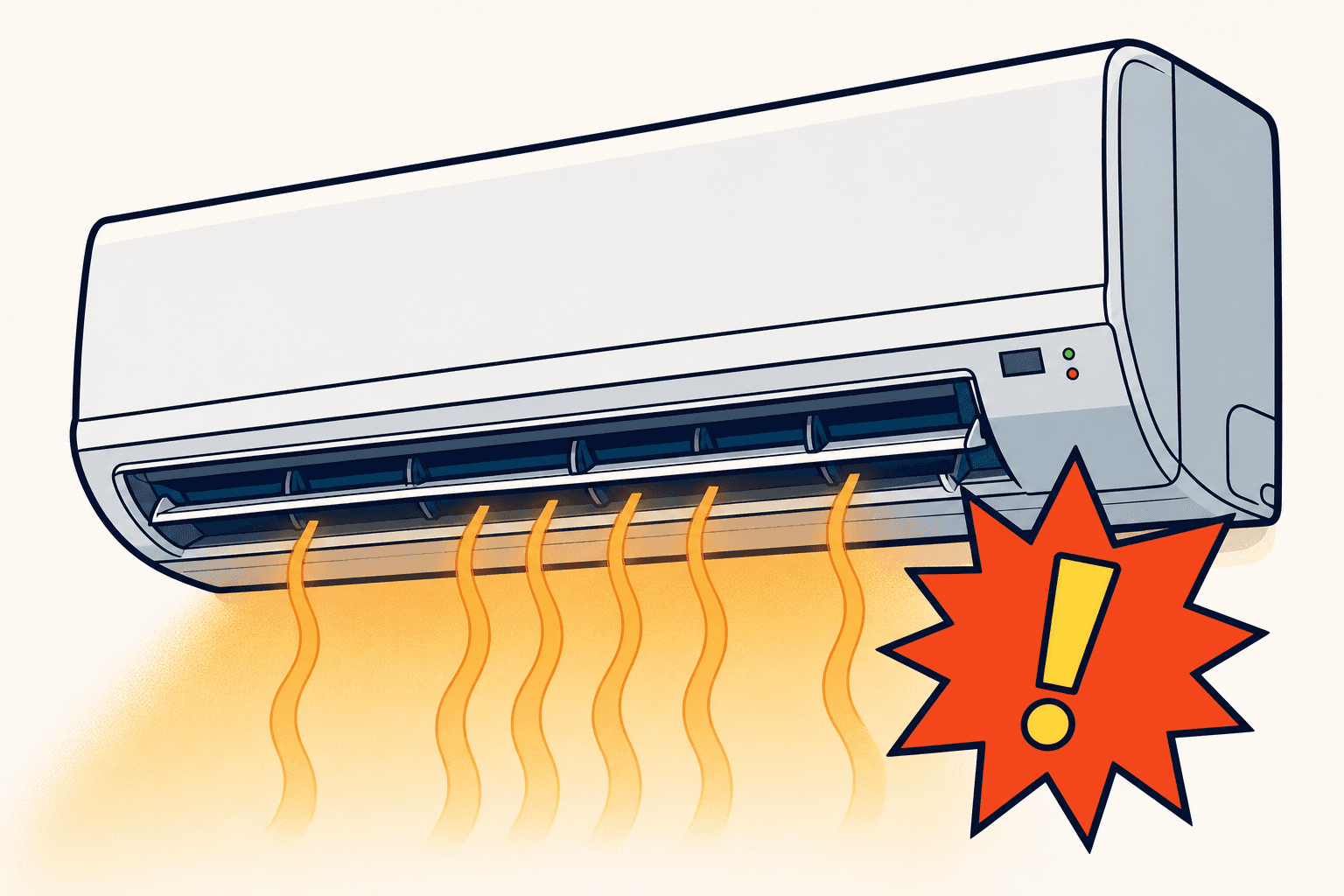
An AC not cooling on a hot day feels like an emergency. Before you book a technician, check the simple causes first: the thermostat, the filter, ice on the coil and the outdoor unit. You can check all of it in half an hour without opening anything electrical. Only a frozen coil takes longer, because the ice has to melt.
Look at what the system is doing. Warm air from the vents while the outdoor unit stays silent points to power, the thermostat or a safety switch. Cool but weak airflow points to the filter or ice. Ice on the copper pipes or on the indoor unit means a frozen coil.
Start With These 30-Second Checks
- 1Set the thermostat to COOL and a few degrees below the room temperature. Replace its batteries if the display is weak or blank.
- 2Go outside: is the big fan on top of the outdoor unit spinning, and is the unit humming?
- 3Feel the air at a vent close to the indoor unit. Weak airflow points to the filter, closed vents or ice.
- 4Look at the copper pipes at the indoor unit for frost or ice.
1. Check the Thermostat
A wrong setting is the cheapest fix there is, and an easy one to miss.
- 1Set the mode to COOL, not HEAT or FAN.
- 2Set the temperature at least 3 degrees below the current room temperature.
- 3Set the fan to AUTO. ON keeps the fan blowing between cycles, which can feel like warm air.
- 4Replace the batteries, and on a smart thermostat check that no schedule or eco mode overrides your setting.
2. Replace the Air Filter
A clogged filter starves the system of air. The house cools slowly, the coil can freeze, and the system works much harder. ENERGY STAR recommends checking the filter every month and changing it at least every three months.
- 1Turn the system off at the thermostat.
- 2Find the filter: in a return grille on a wall or ceiling, or in a slot next to the indoor unit or the furnace.
- 3Note the size printed on its edge and the arrow that shows the airflow direction, then pull it out.
- 4Slide in a new filter with the arrow pointing toward the unit. A basic 16x25x1 filter costs around $6.
- 5Turn the system back on and check the airflow after half an hour.
3. Thaw a Frozen Coil
Ice on the indoor coil blocks the air, so the AC runs but barely cools. Usually the cause is too little airflow, from a dirty filter or closed vents, and sometimes low refrigerant.
- 1Switch cooling off at the thermostat and set the fan to ON, so the blower moves warm room air over the coil.
- 2Lay towels around the base of the indoor unit for the meltwater. Do not chip at the ice: the coil's fins and tubes are thin and easy to puncture.
- 3Wait until all the ice is gone. That can take a few hours, sometimes longer.
- 4Replace a dirty filter, open all the vents and set the fan back to AUTO before you switch cooling back on.
- 5If the coil freezes again, call a technician: that usually means low refrigerant or a fan problem.
4. Clean Around the Outdoor Unit
The outdoor unit gets rid of the heat from inside. Leaves, grass clippings and dirt on its fins trap that heat, and the AC cools less.
Power off before you touch the outdoor unit
The outdoor unit has its own disconnect box on the wall next to it. Pull out its handle or switch it to OFF, and turn off the AC's breaker, before you clean or clear anything. Never open the unit's electrical panel: its capacitor can hold a dangerous charge even with the power off.
- 1Turn the AC off at the thermostat, then pull out the disconnect's handle or switch it to OFF, and turn off the AC's breaker in the panel.
- 2Clear leaves and debris from the top and the sides, and trim plants back so there is open space around the unit, about two feet.
- 3Rinse the fins gently with a garden hose. Never use a pressure washer, it bends the thin fins.
- 4With your hands clear, put the disconnect back on and switch the breaker on, wait a few minutes, then switch cooling on.
5. A Tripped Breaker or Safety Switch
If the indoor fan runs but the outdoor unit stays silent, or nothing runs at all, the power may be cut.
- 1Set the thermostat to OFF and make sure nobody is touching the indoor or outdoor unit. Then check the panel for a tripped AC or furnace breaker and reset it once by pushing it fully off, then on.
- 2If it trips again, leave it off and call a technician, see breaker keeps tripping for what a repeat trip means.
- 3Look at the condensate drain from outside the indoor unit, without opening any panel. Many systems have a float switch that shuts the AC off when the drain backs up, see AC dripping water inside.
- 4Some furnaces have a power switch that looks like a light switch near the unit. Make sure it is on, and that the disconnect next to the outdoor unit is on too. Then switch cooling back on at the thermostat.
🛠️ Tools You Will Need
- •New air filter in the right size - The most common fix
- •Flashlight - Ice on the coil and the copper pipes
- •Garden hose - Rinsing the outdoor fins gently
- •Old towels - Meltwater from a thawing coil
- •Fresh thermostat batteries - A weak display can mean no signal to the AC
Pro tip
Write the filter size and the date you changed it on the edge of the return grille. The next change then takes a minute.
When to Call a Technician
This Old House puts common AC repairs at about $150 to $650, a refrigerant leak repair at $200 to $1,500 or more, and a new compressor at $1,000 to $3,000 or more. None of these are owner jobs:
- 1The outdoor unit hums but its fan does not spin: often a failed capacitor, which holds a dangerous charge.
- 2Ice that comes back after a thaw and a new filter, a hissing sound, or oily spots on the pipes: likely a refrigerant leak. Refrigerant may only be handled by technicians with EPA certification.
- 3A breaker that trips again after one reset.
- 4Warm air even though the filter is new, the coil is free of ice and both units run.
Fix your air conditioner with AI
Describe what your air conditioner is doing and Fixable's AI finds the cause and gives you every step. Or scan its type plate: Fixable finds the operating manual and answers from it, error codes included. Found a repair video for this? Paste the link and get the steps, tools and parts.
Frequently asked questions
How much does it cost to fix an AC that is not cooling?
Often little: a new filter costs around $6 and a thermostat setting costs nothing. This Old House puts common AC repairs, like a frozen coil, a clogged drain or a capacitor, at about $150 to $650, and a refrigerant leak repair at $200 to $1,500 or more. Check the filter and the thermostat first.
How long does a frozen AC take to thaw?
Usually a few hours, sometimes most of a day, depending on how much ice there is and how warm the house is. Switch cooling off and run only the fan to speed it up. Do not chip at the ice, which can puncture the coil, and do not use a heat gun, which can warp the fins.
Why is my AC blowing warm air?
Check the thermostat first: it must be on COOL and set below the room temperature. Then check that the fan on the outdoor unit spins. If the outdoor unit is silent or only hums, a breaker may have tripped or a part like the capacitor has failed, which needs a technician.
Can I add refrigerant to my AC myself?
No. The refrigerant in home central AC may only be bought and handled by technicians with EPA certification, and low refrigerant means a leak that has to be found and fixed first. Adding more without fixing the leak only delays the next breakdown.
STILL STUCK?
Describe what's broken and Fixable's AI finds the cause and gives you every step. Found a repair video? Paste the link. Or scan the type plate and Fixable answers from the manual, with the page.
Open it in your browser, free to try →Free trial · 6 languages · Cancel anytime
Keep Reading
AC Dripping Water Inside the House? 5 Causes (Stop the Leak Today)
Water dripping from your AC into the house is a clear warning. Five causes cover most cases, and you can fix several of them yourself in under 30 minutes. Here is which is which.
No Hot Water in the House? 5 Causes, Easiest First
No hot water anywhere is usually power, gas or the pilot. Cold at one tap only is the faucet. Hot water that runs out fast is the tank. Here is how to tell which, and what you can safely check.