Breaker Keeps Tripping? What It Means and What You Can Safely Check
A breaker that keeps tripping is usually an overloaded circuit, like a space heater and a hair dryer on one breaker. Unplug everything on it, reset the breaker once, then add devices back one at a time. If it trips with nothing plugged in, or you smell burning or see scorch marks, leave it off and call an electrician.

Different model, or still stuck? Describe it in Fixable and get every step for yours.
In this article
When a breaker trips, part of the house goes dark and the switch in the panel sits in the middle or in the off position. It is annoying, but it means the breaker did its job: it cut the power before the wires got too hot. If the breaker keeps tripping, something on that circuit asks for more than it can safely carry.
How fast it trips tells you a lot. A breaker that trips after a few minutes, while something big is running, points to an overload. One that trips the moment you reset it, or with nothing plugged in, points to a short circuit or a ground fault in the wiring, and that is an electrician's job.
Do not keep resetting it
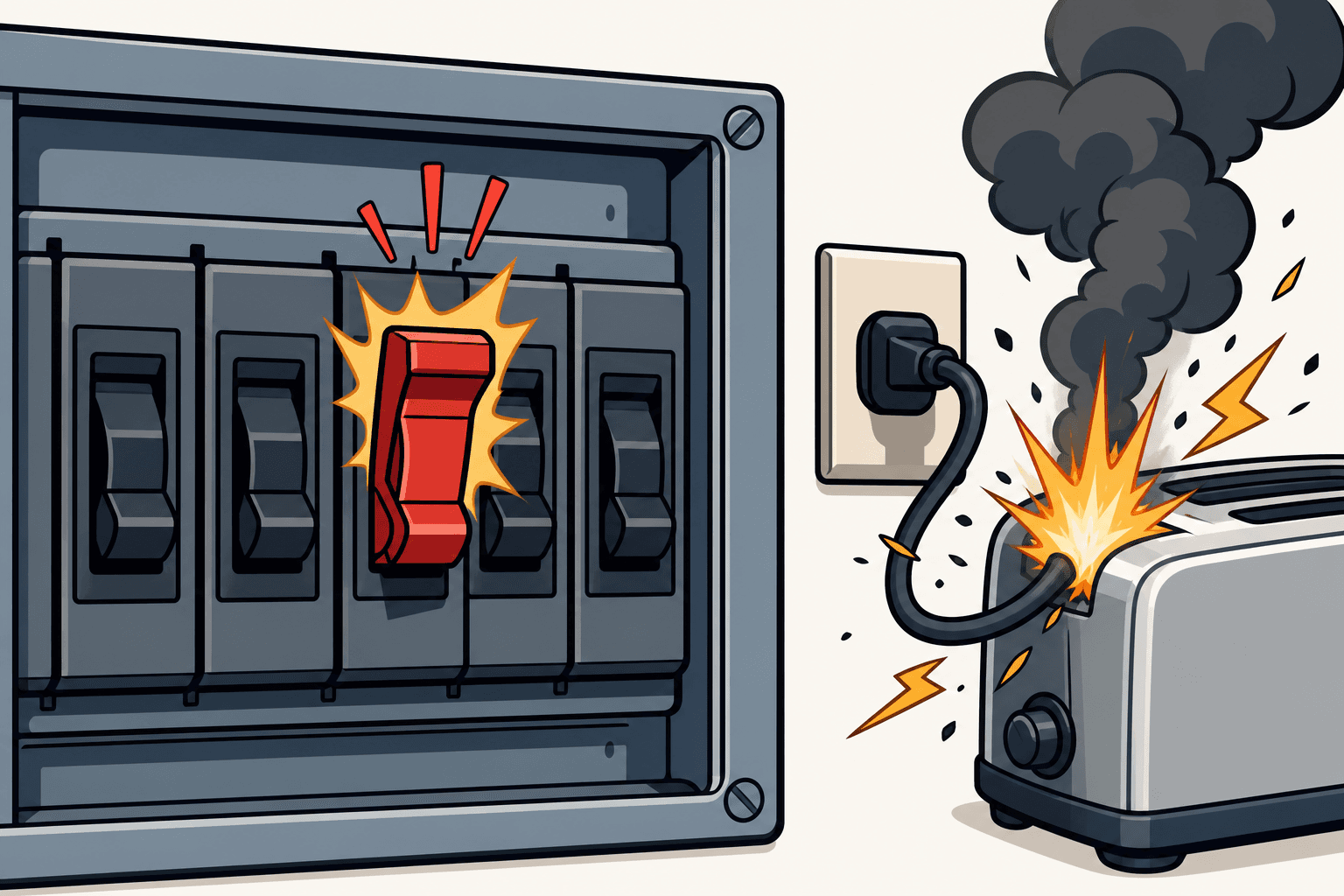
A breaker trips to stop wires from overheating. Resetting it again and again, or holding it on, is a fire risk. Never remove the panel cover, tape a breaker on or put in a bigger breaker. If you smell burning, see scorch marks, or the panel feels hot or buzzes, leave the breaker off and call an electrician. If you see smoke or flames, get everyone out and call 911.
Start With These 30-Second Checks
- 1Note what was running when it tripped: a space heater, a hair dryer, a microwave, a vacuum or a window AC.
- 2Look for scorch marks, a burning smell or a warm cover at the outlets and switches on that circuit. If you find any, stop here and call an electrician.
- 3Check the bathroom, kitchen, garage and outdoor outlets for a GFCI with a tripped button. One GFCI can cut the power to other outlets further along.
- 4Read the labels in the panel to see which rooms the breaker feeds.
1. Reset the Breaker the Right Way
A tripped breaker often sits in the middle position, and it will not turn back on until you push it all the way off first.
- 1Turn off or unplug everything that was running on that circuit.
- 2Stand on a dry floor with dry hands, and open only the panel's small door, never the cover behind it.
- 3Find the breaker that sits in the middle or off position. Push it firmly all the way to OFF, then back to ON.
- 4If it trips again right away with everything unplugged, leave it off and call an electrician.
2. Find an Overloaded Circuit
Each circuit has a limit. A standard 15 amp circuit at 120 volts carries 1,800 watts, and for devices that run for hours it should stay under 80 percent of that, about 1,440 watts. A space heater on high draws around 1,500 watts by itself, so a heater and a hair dryer on the same circuit are enough to trip it.
- 1Unplug everything on the tripped circuit, then reset the breaker as above.
- 2Plug the devices back in and switch them on one at a time, waiting a few minutes after each.
- 3When it trips, note the last device you added and what else was running.
- 4Move heaters, hair dryers and kitchen appliances to outlets on other circuits, or run them at different times.
- 5Plug a space heater straight into a wall outlet, never into an extension cord or a power strip.
3. A Faulty Appliance or Cord
If one device trips the breaker even when nothing else is running, the device itself is likely faulty: a worn cord, a failing motor or water inside it.
- 1Unplug the suspect device and look at the cord and the plug for cuts, melting or burn marks. If you find any, or the device got wet or smells hot, stop here: do not plug it in again, have it repaired or replaced.
- 2Only if it looks fine and is dry: plug it in, switched off, on a different circuit, then switch it on. If that breaker trips too, the device is the problem.
- 3Stop using any device that trips breakers, and have it repaired or replaced.
- 4If the breaker for your central AC is the one that trips, see AC not cooling.
- 5If bulbs on the same circuit also burn out fast, see light bulbs keep burning out.
4. GFCI and AFCI Trips
Newer homes have breakers and outlets that trip for other reasons than overload. A GFCI cuts the power when current leaks to ground, for example through water. An AFCI cuts it when it detects arcing, such as from a damaged cord or a loose connection.
- 1Look before you touch: if the GFCI outlet or the wall around it is wet, do not touch it. Leave it off until it is completely dry, and if water keeps getting in, switch off its breaker.
- 2Unplug everything on the GFCI and the outlets after it, then press its RESET button firmly.
- 3Plug the devices back in one at a time to find the one that trips the GFCI or the AFCI every time.
- 4An AFCI that trips often with nothing obvious plugged in can mean damaged wiring or a loose connection: call an electrician.
5. A Worn Breaker or a Wiring Fault
Breakers can wear out after many trips, and wiring faults hide in the walls. Neither is something to fix yourself.
- 1A breaker that trips with nothing on the circuit, or that feels warm, needs an electrician.
- 2A buzzing or crackling panel, or a burning smell from an outlet: switch that breaker off if you can do so safely, and call an electrician the same day.
- 3Breakers get replaced only by an electrician, with the type and rating the panel is made for.
- 4HomeAdvisor puts an electrician's service call at about $100 to $200 for the first hour. Fixr puts fixing a breaker that keeps tripping at $200 to $2,000, depending on the cause.
🛠️ Tools You Will Need
- •Flashlight - Reading the panel labels
- •Plug-in outlet tester - Shows common wiring faults at an outlet without opening anything
- •Pen and paper - Noting which devices were running and which outlets each breaker feeds
Pro tip
Label the breakers while you test. When you know which outlets each one feeds, the next trip takes a minute to sort out.
Fix it with AI
Describe what is happening and Fixable's AI finds the cause and gives you every step. Found a video for this? Paste the link and get the diagnosis, the tools and the parts, without scrubbing through the whole video.
Frequently asked questions
How much does it cost to fix a breaker that keeps tripping?
Finding an overload yourself costs nothing, as long as the breaker holds with nothing plugged in and nothing smells burnt. HomeAdvisor puts an electrician's service call at about $100 to $200 for the first hour, and Fixr puts fixing a breaker that keeps tripping at $200 to $2,000, depending on whether the panel or the wiring needs work.
Can I replace a circuit breaker myself?
That is a job for a licensed electrician. Changing a breaker means opening the panel, where the main wires stay live even with every breaker off, and the new breaker must match the panel's type and rating. You can reset a breaker once and look for overloads yourself; leave it off if it trips again at once or smells burnt.
Why does my breaker trip with nothing plugged in?
Then the fault is most likely in the wiring, the breaker or something wired in, like a light fixture or a bathroom fan: a short circuit, a ground fault or a worn breaker. Leave the breaker off, do not keep resetting it, and call an electrician.
Is a breaker that keeps tripping dangerous?
The trip itself protects you, but the cause can be dangerous. An overload is harmless once you spread the devices out. A breaker that trips at once, a burning smell, scorch marks or a warm panel point to a fault that can start a fire, so leave it off and call an electrician.
STILL STUCK?
Describe what's broken and Fixable's AI finds the cause and gives you every step. Found a repair video? Paste the link. Or scan the type plate and Fixable answers from the manual, with the page.
Open it in your browser, free to try →Free trial · 6 languages · Cancel anytime
Keep Reading
Lights Flickering? 5 Causes and What You Can Safely Check
Flickering lights are usually a loose or wrong bulb, but sometimes they warn of a loose wire. Here is how to tell the two apart, and what to leave to an electrician.
Light Bulbs Keep Burning Out Fast? 6 Causes (And How to Stop It)
Light bulbs are rated for 1,000-25,000 hours. If yours die in weeks, it is usually not the bulbs. It is one of six specific problems with the fixture, wiring, or environment. Here is how to find which.