LG Washer UE Error: 5 Fixes for an Unbalanced Load
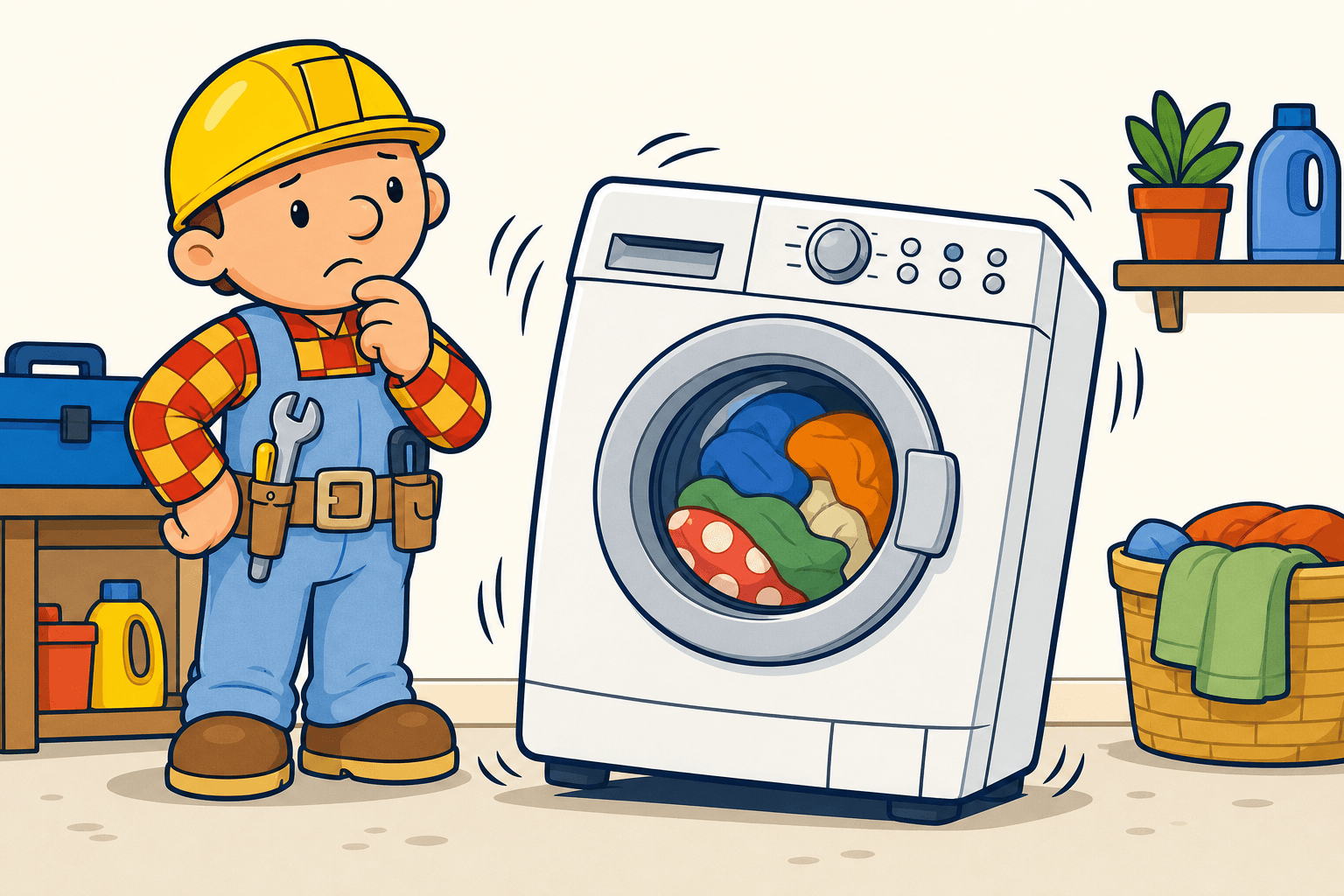
On most LG machines of the last 15 years, UE (or uE, Ub) means the drum could not balance the load. Press Start/Pause, wait for the door to unlock, then spread the laundry evenly, adding towels to a single heavy item or taking some out of a crammed drum. Restart on Spin Only: ten minutes, no cost.
In this article
- 01Start With These 30-Second Checks
- 021. Redistribute the Load and Stop Spinning One Heavy Thing Alone
- 032. Level the Washer and Look at What It Stands On
- 043. Run the Calibration Cycle After Anything Moves
- 054. Check for Shipping Bolts on a New or Recently Moved Machine
- 065. Worn Suspension Rods or Shock Absorbers
- 07Tools You Will Probably Need
- 08When to Call a Pro
Your LG washer has stopped part way through the spin, the drum is full of wet laundry, and the display reads UE. Nothing dramatic has broken. UE is the machine refusing to spin a load it thinks is lopsided, because a drum turning at 1,000 rpm or more with all the weight on one side would walk across the laundry room. On most LG washers of the last 15 years, front loaders and top loaders alike, uE, UE and Ub all point at the same thing: balance. A few older series and some non-US models label things differently, so if your manual says otherwise, trust the manual.
One question splits this into two very different repairs: does UE show up on this one load, or on every load? A single waterlogged bath mat is enough to trigger it on a perfectly healthy machine, and that is a two minute fix with nothing to buy. UE on every load, including small ones, means the machine cannot hold the drum steady on its own, which is fixes 2, 4 and 5 below. If the drum does not turn at all, even with nothing in it, this is not a balance problem and you should start with a washer that will not spin.
Start With These 30-Second Checks
- 1Before anything goes inside the machine, press Start/Pause, wait for the door lock to click open and for the drum to stop turning completely, then pull the plug at the wall. The drum coasts for up to a minute after a spin, and a paused washer is still live.
- 2Read the case of the letters. Lowercase uE means the washer is still trying to rebalance by itself, adding water and rocking the drum back and forth, and that is worth a few minutes before you stop the cycle. Uppercase UE means it gave up after about three attempts and is waiting for you. Then look at the load: one bath mat, one hoodie or one heavy towel on its own is the single most common cause of UE.
- 3Push down on each of the four top corners of the cabinet in turn. If any corner drops or the machine rocks, it is not level, and that alone produces UE on load after load.
- 4Check that nothing is trapped, with the plug already out. On a front loader, use a flashlight and feel around the rubber door gasket with the back of your fingers rather than your fingertips: underwires, screws and glass shards collect in that fold. On a top loader, look for a sock pulled over the rim of the inner basket.
- 5Note how wet the clothes are. Damp is normal after an interrupted spin. Soaking wet and dripping usually means the water never left, which is a drain problem rather than a balance one, and the LG OE drain error covers that path.
1. Redistribute the Load and Stop Spinning One Heavy Thing Alone
The washer measures how the weight sits in the drum before it commits to a high speed spin. One soaked bath mat on one side weighs several pounds more than the air on the other side, and no amount of retrying changes that arithmetic. This is the fix for the large majority of UE calls.
- 1Press Start/Pause, wait for the door lock to release and for the drum to stop turning, then pull the plug at the wall before your hands go in. On front loaders the lock can take up to two minutes to let go. Do not force the door, the latch breaks before it opens.
- 2If the machine stopped on a spin straight after a hot or sanitary wash, the water and the laundry are still hot enough to scald. Let the door stand open for ten minutes before you reach in.
- 3Open the door and pull the laundry away from the drum wall. Wet fabric sticks itself into one solid lump on the side it was flung to.
- 4Spread everything evenly around the drum rather than dropping it in a pile at the bottom.
- 5If you are washing one heavy item, a bath mat, comforter, hoodie or single towel, add two or three items of similar size to balance it. If the drum was crammed, take some out. Two thirds full is where these machines balance best.
- 6Take your hands out of the drum, check the gasket fold is clear and nothing hangs over the rim, then close the door and select Spin Only or Drain and Spin. Stand clear while it comes up to speed. If it bangs against the wall or starts walking across the floor, press Start/Pause or pull the plug, never try to hold it still: 200 pounds at speed will not be pushed back. If UE comes back, drop the spin speed one step, medium instead of high, and run it again.
A tiny load fails the same way a huge one does
Overloading is the obvious mistake. An almost empty drum is just as bad: three t-shirts have nothing to counterbalance them once the drum is up to speed, so the machine reads the weight as all on one side. Aim for two thirds full either way.
2. Level the Washer and Look at What It Stands On
A washer that rocks even slightly cannot damp out the wobble it creates, so the sensor sees imbalance on loads that would be fine on a steady machine. This is the most common reason UE keeps coming back, and it costs nothing but about 15 minutes.
Unplug it before your hands go underneath
An LG washer weighs 150 to 250 pounds and the leveling feet sit directly under all of it. Pull the plug at the wall first, shut both supply taps if you are going to slide the machine out, and get a second person for the tilt. Never hold the machine up with your body while your other hand is under the base.
- 1Unplug the washer and shut off the hot and cold supply taps before you move it at all.
- 2Set a spirit level on top of the machine, front to back first, then side to side. A phone level app is accurate enough for this.
- 3Loosen the lock nut on each leveling foot with an adjustable wrench, turning the nut down toward the floor.
- 4Turn a foot clockwise to raise that corner, counterclockwise to lower it. Keep the machine as low as it will sit while still being level. Height is what lets it rock.
- 5Push each top corner diagonally with the machine back in place. Nothing should move. Then tighten each lock nut back up against the cabinet so the feet cannot drift loose again.
- 6Check the floor itself. If it flexes, as a wooden floor over a crawlspace does, a sheet of 3/4 inch plywood under the machine does more for UE than any adjustment to the feet. A rug bunched under one foot or a cracked tile has the same effect as a short leg.
3. Run the Calibration Cycle After Anything Moves
LG washers store a reference for what an empty, balanced drum feels like. Move the machine, relevel it or replace a part, and that stored reference is now wrong, so the washer can call a perfectly normal load unbalanced. The routine is free and takes a few minutes.
- 1Button names vary by series. The combination below fits most recent LG models, but if it does nothing on yours, look up calibration or tub calibration in the manual rather than trying other button pairs: some combinations open the service test mode, which fills the machine and spins the drum on its own.
- 2Empty the drum completely and close the door. Calibration with laundry inside is worse than useless, because the machine learns the wrong reference.
- 3Keep hands, tools and pets clear of the machine. It powers up and spins the drum on its own during this routine.
- 4With the washer off, press and hold Spin Speed and Soil Level together, then press Power. Most models show CB or Cb on the display.
- 5Press Start/Pause. The drum turns slowly, then spins, then stops by itself after a few minutes.
- 6Let it run to the end without opening the door, then wash a normal load and see whether UE returns.
4. Check for Shipping Bolts on a New or Recently Moved Machine
If UE appeared on the very first load in a new house, or on a machine that has just been delivered, read this section before anything else. LG front loaders ship with four bolts through the back panel that clamp the tub rigidly to the cabinet. Left in place, the tub cannot move at all, so every single load reads as violent imbalance and the machine shakes hard enough to damage itself.
Get help before you pull it out from the wall
An LG washer weighs 150 to 250 pounds and the hoses and the cord stay attached while you move it. Unplug it and shut both taps first, then walk it out with a second person, one corner at a time, and keep enough slack in the hoses that nothing pulls tight. Work with the machine standing on the floor, never tilted against your knee.
- 1Unplug the washer, shut off both supply taps, and walk it out from the wall with a second person before you go behind it.
- 2Open the door, pull the drum toward you and push it back. A drum with a little give has had the bolts removed. A drum that will not move at all still has them in.
- 3Look at the back panel for four bolts with rubber or plastic collars, usually set out in a rectangle.
- 4Undo them counterclockwise with the wrench that came in the accessory bag, then pull each bolt out together with its plastic sleeve. Keep the whole set, you need it if the machine is ever moved again.
- 5Press the four hole caps from the accessory bag into the empty holes so nothing gets into the cabinet.
- 6Check the base too. A laundry pedestal that is not bolted to the machine, or a stacking kit fitted loosely, produces the same error for the same reason.
5. Worn Suspension Rods or Shock Absorbers
If the machine is level, calibrated and evenly loaded and still says UE, the parts that hold the drum steady have worn out. Top loaders hang the tub on four suspension rods, one at each corner. Front loaders sit it on two or four shock absorbers. Both tend to give up somewhere around 7 to 10 years, and both let the drum swing far enough to trip the sensor on loads that used to be fine.
Power off, water off, and drain it before any panel comes off
This is the first fix that goes inside the cabinet. Unplug the machine at the wall, shut both supply taps, and empty the remaining water through the drain pump filter behind the lower access panel before you tip or open anything. The water in the tub and behind the filter cap can still be scalding after a hot or sanitary cycle, so let the machine stand for an hour before you open it. A tub with water still in it shifts weight without warning while you are holding it. If you find a snapped rod or a drum that visibly sags to one side, stop running the machine until it is repaired.
- 1Unplug the washer and shut off both supply taps. If the last cycle was a hot one, let it stand an hour so the water in the tub cools. Then kneel to the side, not in front of the cap, put a shallow tray and a towel underneath, and open the drain pump filter a quarter turn at a time so the water comes out under control.
- 2On a top loader, lift the top panel and look at the four rods running from the corners of the tub down to the base. A worn one has a bare shiny shaft, a split plastic ball cup, or no resistance left at all. Test them by hand: push the empty drum down about four inches and let go. It should rise slowly and settle, and if it bounces two or three times the rods are done.
- 3On a front loader, take off the rear panel to reach the shock absorbers between the tub and the base. Pull each one along its axis. A healthy damper resists firmly, a dead one slides like an empty tube.
- 4Before the last rod or damper comes off, take the weight of the tub: block it from below with a length of timber, or have a second person hold it. Top load rods carry a compressed spring in the ball cup that snaps back when it is released, and on a front loader the concrete counterweights make the tub far heavier than it looks. Never let the tub hang on the one damper that is left.
- 5Replace them as a complete set, never one at a time, and order by your model number. Four top load rods run roughly $40 to $90 depending on the series, a pair of front load shock absorbers roughly $25 to $70. A technician doing the same job usually comes to $150 to $300 including labor.
- 6Plug the machine back in only once your hands and tools are out of the cabinet and the panels are back on. Then run the calibration cycle from fix 3, followed by a spin with an empty drum, before you trust it with laundry again.
Tools You Will Probably Need
🛠️ Tools You Will Need
- •Adjustable wrench - Leveling foot lock nuts, and the shipping bolts on the back panel
- •Spirit level or a phone level app - The only honest way to know the machine is level front to back and side to side
- •Flashlight - Seeing into the door gasket fold, and the feet and floor under the machine
- •Shallow tray and an old towel - Catching the water at the drain pump filter before any panel comes off
- •Nut driver or socket set - Rear panel screws on a front loader, top panel screws on a top loader
- •Short length of timber - Blocking the tub from below so it cannot drop when the last rod or damper comes off
When to Call a Pro
The line is clear. Load, leveling, calibration, shipping bolts and suspension parts are all owner jobs. Anything making noise from inside the sealed tub is not.
- 1A grinding or rumbling noise during spin that has been getting louder for weeks is usually the drum bearing. On most front loaders that means replacing the whole outer tub, which often costs more than half the price of a new machine. Get a written quote before you agree to it.
- 2UE that appears with an empty drum, before any laundry has gone in, points at the motor's rotor position sensor or the control board rather than at balance. That needs a meter and a service manual.
- 3If the drum has obvious side to side play, or you can see the tub touching the cabinet during spin, stop using the machine and book the call. Every further cycle makes the damage worse.
- 4Ask the technician to confirm the leveling and run the tub calibration before quoting parts. It is the cheapest item on the list and it is the one most often skipped.
- 5Budget $100 to $200 for the visit and diagnosis before parts, and weigh that against the age of the machine. Past 10 years, a suspension job plus a bearing usually costs more than the washer is worth.
Stuck on a step?
Fixable can analyse a photo of your specific LG washer, tell you which suspension part you are looking at, and walk you through the exact fix step by step.
Frequently asked questions
How much does it cost to fix a UE error on an LG washer?
Usually nothing. Redistributing the load and leveling the feet clear most UE cases and cost only your time. Worn suspension runs roughly $40 to $90 for four top load rods, or $25 to $70 for front load shock absorbers. A service call is $100 to $200 before parts, so on a washer past 10 years weigh that against replacing it.
Can I fix an LG UE error without a technician?
In most cases yes. Redistributing the load, leveling the feet and running the calibration routine are owner jobs with no panels off. Unplug before your hands go under the machine, and keep clear during calibration, the drum spins on its own. Button names vary by series. Call someone if you hear grinding during spin.
Will the UE error come back after I redistribute the load?
Not if it was a one time thing, like a single bath mat washed alone. If UE returns within the next few loads, including small ones, the usual causes are a machine that is not level, shipping bolts left in a newly delivered washer, or worn suspension. Two thirds full is what these drums balance best.
My clothes are soaking wet after a UE error, do I need to wash them again?
No. Once the door has unlocked, spread them evenly around the drum, close it and run Spin Only or Drain and Spin at medium speed. They come out wearable in about 10 minutes. If they stay soaking wet after a full spin, the drain pump filter is probably blocked, not the balance.
STUCK ON YOUR REPAIR?
Paste any video link or just describe the problem. Fixable turns it into a clean step-by-step guide with images, tools, and parts.
Try it free in your browser, no install →3-day free trial · 7 languages · Cancel anytime
Keep Reading
Samsung Refrigerator OF OF Error: Turn Cooling Back On in 60 Seconds
OF OF is not a broken fridge. It is Cooling Off mode, the showroom setting, and it switches the compressor off. Here is the button combination for each Samsung panel and what to do when it will not clear.
LG Dryer D80, D90 and D95: Clear the Vent and Clear the Code
D80, D90 and D95 all say the same thing: lint is choking your dryer's exhaust. The difference is how badly. Here is how to find the blockage, clear it, and stop the code coming back.