Washing Machine Not Spinning? 6 Fixes to Try First
An unbalanced load is the most likely cause. Open the lid, spread the clothes evenly around the drum, and run a Spin Only cycle. That takes two minutes and costs nothing. If it still will not spin, check the lid switch, drain pump, or drive belt, roughly $15 to $60 in parts.
In this article
- 01Start With These 30-Second Checks
- 021. Unbalanced Load (The Most Common Cause)
- 032. Lid Switch or Door Latch Failure
- 043. Drain Pump Clogged or Failed
- 054. Drive Belt Broken or Slipped
- 065. Motor Coupling Worn (Direct-Drive Top-Loaders)
- 076. Control Board or Speed Sensor (Last Resort)
- 08Tools You Will Probably Need
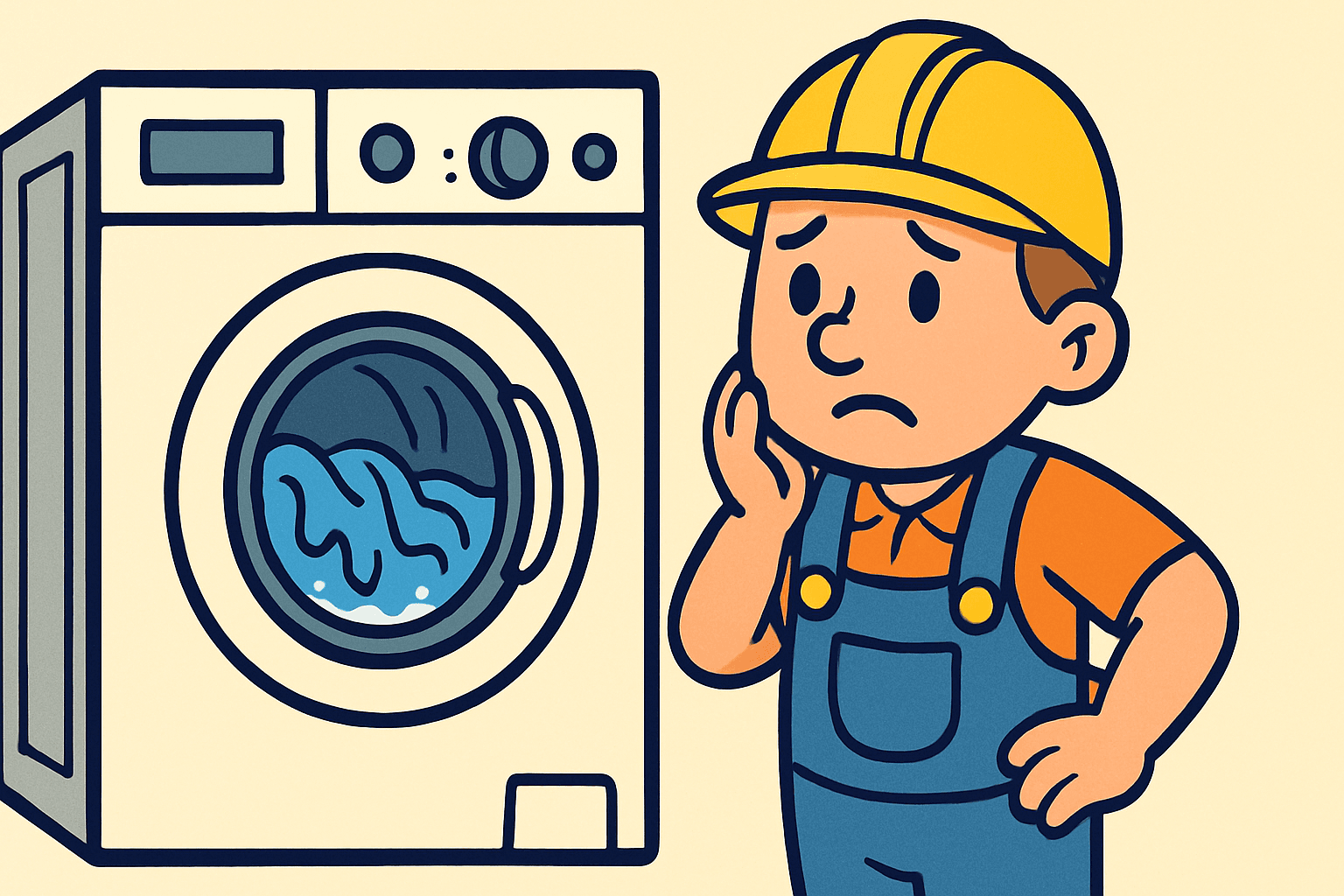
The cycle finishes, you open the lid, and your clothes are dripping wet at the bottom of a half-full drum. The washer ran the wash, drained, but skipped the spin. Annoying, especially when the next move is wringing out towels by hand. The good news: this is one of the most common appliance problems and the cause is almost always one of six things.
Before you go deeper, do one test. Move the load by hand to the center of the drum, close the lid, and start a Spin Only cycle. If the washer spins normally with a centered load, your problem is unbalanced loads tripping the safety. If it still does not spin, the issue is mechanical or electrical and the next sections apply.
Start With These 30-Second Checks
- 1Open the lid and rebalance the load. A wadded-up comforter on one side will absolutely stop the spin.
- 2Listen during the spin phase - is the motor humming, completely silent, or buzzing then stopping? Each sound points to a different cause.
- 3Check that the washer is level - put a small spirit level on top and adjust the front feet if needed.
- 4Confirm there is no error code on the display - some models show codes for 30 seconds before clearing themselves.
1. Unbalanced Load (The Most Common Cause)
Modern washers detect imbalance and abort the spin to protect themselves from walking across the room. A single heavy item like a wet comforter, a pair of jeans bunched up, or three towels piled together will trip the sensor every time.
- 1Open the lid and redistribute clothes evenly around the drum.
- 2Add a few smaller items (a couple of t-shirts) to balance a single heavy piece like a comforter.
- 3Run a Spin Only or Drain and Spin cycle to test.
- 4If it still aborts, your load is too small - some washers refuse to spin loads under 2 pounds. Add a towel or two.
2. Lid Switch or Door Latch Failure
The washer will not spin if it cannot detect a closed lid or door. Top-load machines use a small plastic switch under the rim, front-load machines use an electromagnetic latch. Both fail with normal use over a few years.
- 1Top-loaders: open the lid and look for a small plastic post or button near the front of the rim. Push it firmly with your finger - you should feel a click.
- 2Try a Spin Only cycle while pressing the lid switch with the lid open. If it spins, the switch or the lid alignment is the issue.
- 3Front-loaders: look at the latch in the door frame. The metal hook should engage cleanly. A bent hook needs replacement.
- 4Replacement is $15 to $40 and takes 20 minutes - one of the easiest washer repairs.
Unplug first, always
Before opening any panel on a washer, unplug it and turn off the water supply. Stored capacitor energy and live water lines are both real hazards on modern machines.
3. Drain Pump Clogged or Failed
The washer is supposed to drain before it spins. If the drain is too slow or blocked, the spin never starts. You will usually see standing water in the drum at the end of the cycle.
- 1Front-loaders: open the small access panel at the bottom front, place a shallow pan under the pump, unscrew the filter, and clean out the lint, coins, hair pins, and small socks.
- 2Top-loaders: pull the washer out, tip it gently, and find the pump at the bottom rear. Disconnect the inlet hose and check for foreign objects.
- 3Run a small object on a string through the drain hose to feel for kinks or full blockages.
- 4Test the pump by listening - on a drain cycle, the pump should hum and you should feel water moving. Silent pump usually means burned out, $30 to $60 to replace.
4. Drive Belt Broken or Slipped
Most washers use a rubber belt to transfer motor power to the drum. After 7 to 10 years the belt cracks, stretches, or snaps. The motor will run fine but the drum stays still.
- 1Unplug the washer and pull it away from the wall.
- 2Top-loaders: remove the rear panel (4 to 6 screws). Front-loaders: remove the rear panel as well, sometimes also a top panel.
- 3Locate the belt - it is the only rubber loop running between the motor pulley and the drum pulley.
- 4Inspect for cracks, glazed shiny spots, or a fully snapped piece lying in the bottom.
- 5Replacement is $15 to $30, model-specific, and takes about 30 minutes once you have the panel off.
5. Motor Coupling Worn (Direct-Drive Top-Loaders)
Whirlpool and Kenmore direct-drive top-loaders from the last 20 years use a small plastic and rubber coupling between the motor and the transmission. It is designed to fail before the motor itself, which is good news because it costs $10.
- 1If your machine agitates fine but does not spin, and there is a burning rubber smell, suspect the coupling.
- 2Unplug, disconnect water and drain hoses, lay the washer on its back.
- 3Remove the bolts holding the motor (usually 2 large bolts).
- 4Pull the motor away from the transmission - the coupling will be in pieces.
- 5Install a new coupling, reverse the steps to reassemble. Total time: 45 minutes if you have done it before, 90 minutes if not.
Pro tip
When replacing a motor coupling, also replace the small bolts that hold the motor. The original ones are often corroded after 10 years and will round off the next time you need them out.
6. Control Board or Speed Sensor (Last Resort)
If you have ruled out lid switch, drain, belt, and coupling, the issue is in the electronics. The control board sends the spin command, the speed sensor reads RPM, and either failing causes the same symptom.
- 1Look up your model and any error codes you have seen - some boards self-report.
- 2Test the speed sensor first if your washer has one (rotor position sensor on direct-drive front-loaders) - sensors are $30 and easier to swap than the board.
- 3Control boards are $150 to $300 and require model-specific programming on some brands.
- 4If your washer is over 10 years old, get a quote on a new washer first. Repairs over 50% of replacement cost rarely make sense.
Tools You Will Probably Need
🛠️ Tools You Will Need
- •Phillips and flat screwdrivers - Removing access panels and motor brackets
- •Socket set with extension - Motor and pump bolts often live in tight spaces
- •Multimeter - Testing the lid switch and any sensor for continuity
- •Replacement drive belt or coupling - Order before you start - matched to your model number
- •Shallow pan and old towels - Catching residual water in the drain pump and hoses
Stuck mid-repair?
Snap a photo of your washing machine's open back panel or the part you are testing, and Fixable's AI tells you exactly which component you are looking at and what comes next. Free for 3 days.
Frequently asked questions
How much does it cost to fix a washing machine that will not spin?
Parts are cheap for most causes: a motor coupling is about $10, a drive belt $15 to $30, a lid switch $15 to $40, a drain pump $30 to $60. Control boards are the outlier at $150 to $300. A service call usually starts around $100 before parts.
Can I replace the drive belt myself or do I need a technician?
The belt is a DIY job for most people: unplug the machine, take off the rear panel, four to six screws, and swap it in about 30 minutes. Call an appliance technician if you find scorched wiring, a burnt smell from the terminal block, or the fault points to the control board.
If it spins after I rebalance the load, will it happen again?
Usually yes, if you keep washing single heavy items. One comforter or a bath mat on its own will trip the imbalance sensor most times. Add two or three smaller items to spread the weight, and check the machine sits level. If a normal even load still aborts, suspect the suspension or the speed sensor.
Is it bad to keep running the cycle if the motor just hums?
No. A motor that hums but cannot turn the drum is drawing stall current, and running it repeatedly can cook the winding or shred a motor coupling that was only partly worn. Stop the cycle within about 30 seconds of the hum, unplug the machine, and check the belt or coupling before trying again.
STUCK ON YOUR REPAIR?
Paste any video link or just describe the problem. Fixable turns it into a clean step-by-step guide with images, tools, and parts.
Try it free in your browser, no install →3-day free trial · 7 languages · Cancel anytime
Keep Reading
Samsung Refrigerator OF OF Error: Turn Cooling Back On in 60 Seconds
OF OF is not a broken fridge. It is Cooling Off mode, the showroom setting, and it switches the compressor off. Here is the button combination for each Samsung panel and what to do when it will not clear.
LG Dryer D80, D90 and D95: Clear the Vent and Clear the Code
D80, D90 and D95 all say the same thing: lint is choking your dryer's exhaust. The difference is how badly. Here is how to find the blockage, clear it, and stop the code coming back.