Kitchen Sink Clogged? 6 Fixes Before You Reach for Drain Cleaner
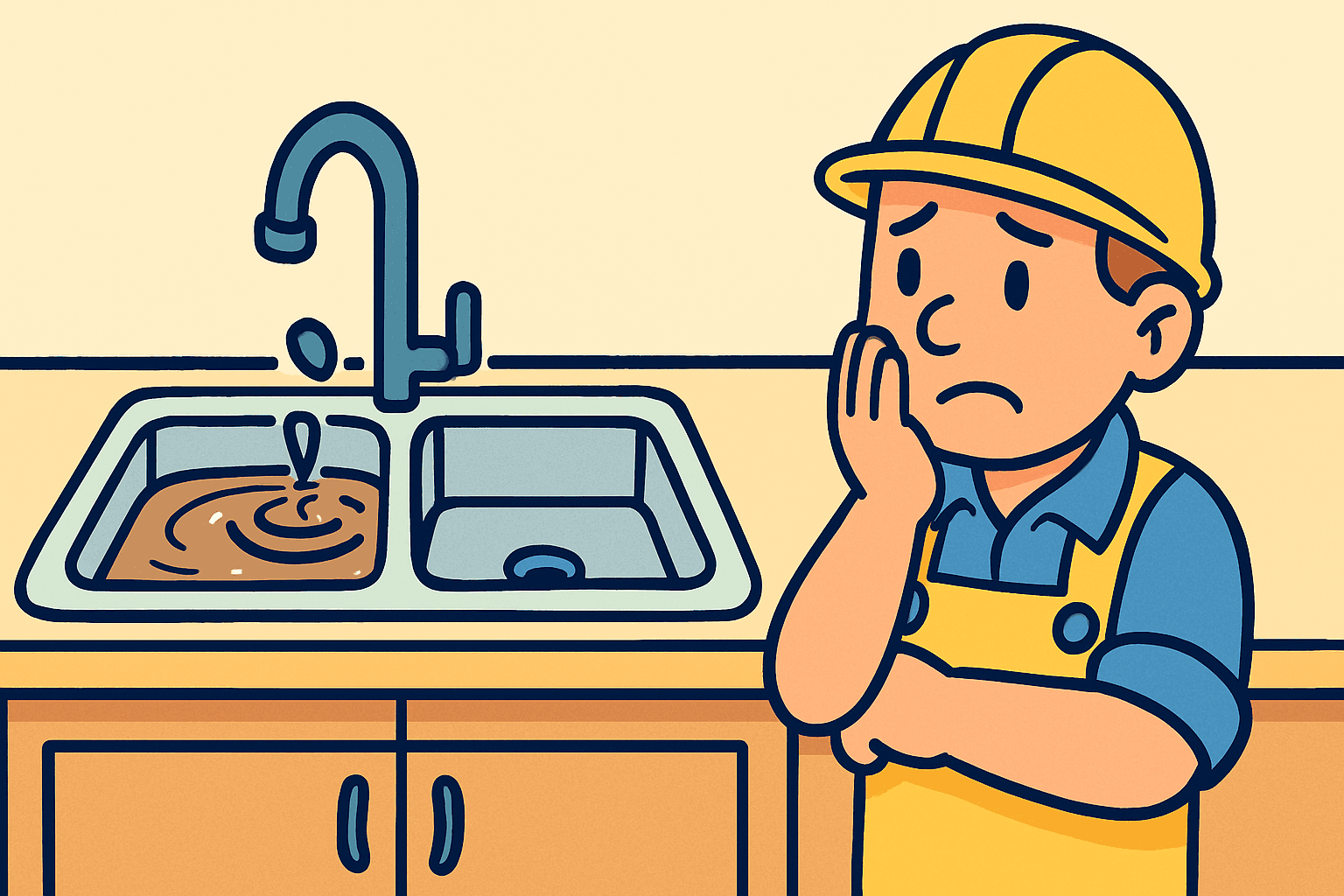
A clogged kitchen sink is usually a grease plug in the P-trap under the cabinet. Wear gloves and goggles, bail the bowls dry, set a bucket under the bend, unscrew both slip nuts and pull the trap off. About 20 minutes. If drain cleaner went down, that water stays caustic: flush cold water through only if the sink still drains, never into a sink that holds water.
In this article
- 01Start With These 30-Second Checks
- 021. Melt the Grease With Hot Water and Dish Soap
- 032. Plunge It, Properly This Time
- 043. Take the P-Trap Apart and Clean It
- 054. Snake the Branch Line in the Wall
- 065. Rule Out the Garbage Disposal
- 076. Blocked Vent or Main Line, and Where You Stop
- 08What You Actually Need
The water has not moved in ten minutes and grease films the top. The blockage is usually within arm's reach, under the cabinet.
One question first, because it splits this into two jobs. Is the kitchen sink the only slow fixture? Run the bathroom basin for thirty seconds and listen at the tub and toilet. Keep the volumes small: if the main is blocked, a tub emptied at once comes back up through the lowest drain in the house. If the others drain quietly, your clog is at the kitchen sink. If they gurgle, burp or rise, the fault is shared and nothing under your sink will fix it. Step 6 separates a blocked vent from a blocked main.
Start With These 30-Second Checks
Read this first if drain cleaner already went down
Caustic cleaner does not disappear. It stays active for hours in the water standing in the bowl and in the trap. Do not run the disposal into it and do not plunge it: both throw that liquid back at your face. Do not open the trap without goggles and gloves. Bail the water into a bucket you can lid. Flush cold water for five minutes only if the sink is still draining, because on a sink that holds water the flush goes over the rim. Tell the plumber what went down.
- 1Water rising in the second bowl while the first drains means the clog is past the tee where they join.
- 2If there is a disposal, look in the bowl before you touch the switch. Never run it into standing water that had drain cleaner in it, and never flick it twice. Three seconds tells you enough: a hum with no spin is a jam. Silence usually means the overload tripped. Step 5 covers both, power off first.
- 3Check the dishwasher. Water in its tub too points at the line they share, and our dishwasher drain guide covers that side.
- 4Look for a cleanout, a capped fitting under the sink or behind it. Your cable goes in there, not through the trap.
1. Melt the Grease With Hot Water and Dish Soap
Kitchen clogs are mostly cooking fat: down warm, set hard on a cold pipe. If the sink still moves, heat and soap often clear it.
- 1Bail the standing water into a bucket first, in gloves and goggles if drain cleaner went down in the last day. Hot water poured on cold water never reaches the clog.
- 2Squirt a quarter cup of dish soap in so the fat breaks up instead of sliding as one lump.
- 3Run the hot tap at full flow for five minutes. Around 120 Fahrenheit softens fat and is safe for plastic pipe.
- 4Skip the kettle. Boiling water at 212 Fahrenheit deforms the rubber slip washers on a plastic trap, trading a clog for a drip.
2. Plunge It, Properly This Time
A plunger only works in a sealed system. On a double sink half your force goes up the other drain.
- 1Do not plunge at all if drain cleaner went down in the last day. The stroke throws that liquid back at your face. Bail the bowl into a bucket you can lid, and go to step 3 in gloves and goggles. Flush cold water through for five minutes only if the sink is still draining: on a sink that holds water it comes back over the rim.
- 2Use a flat cup plunger, or fold a toilet plunger's flange up inside the cup so it seals on the sink floor.
- 3Block the second bowl with a wet rag, held down by a full pot.
- 4Fill the bowl with two inches of water so the cup is submerged.
- 5Twenty firm strokes with the cup flat, then rip it off sharply on the last one to tear the plug loose.
3. Take the P-Trap Apart and Clean It
Most kitchen clogs live here: the U bend under the cabinet, roughly 18 inches down. Worth opening even if the water moved again.
- 1Put on rubber gloves and safety glasses before anything comes apart. Bail both bowls dry into a bucket you can put a lid on, even if you skipped step 1: gallons stand above the trap and it all drops the moment the trap opens.
- 2If drain cleaner went down in the last day, do not try to dilute it. Flush cold water through only if the sink is still draining, even slowly. On a sink that holds water, flushing adds gallons of caustic that has nowhere to go but over the rim. Either way the trap below is still full of it, so keep the bucket directly under the joint and open it slowly.
- 3Unscrew the two slip nuts counterclockwise, usually hand tight. If one resists, use channel lock pliers with a rag around it so the plastic does not crack.
- 4Pull the trap off and push the grey plug of grease and food out with a bottle brush.
- 5Work a bent coat hanger into the trap arm running into the wall; the first six inches catches a lot.
- 6Reassemble with the tapered edge of each slip washer facing into the fitting it seals, taper pointing away from the nut you tighten. Hand tight plus an eighth of a turn, then watch both joints under running water for 30 seconds. A weeping nut gets one more eighth, never full force.
4. Snake the Branch Line in the Wall
If the trap came out clean, or the sink backed up within a day, the blockage is in the wall. A drum auger costs about 30 dollars.
- 1Stop before the cable goes in if the pipe is old galvanized steel, if two or more fixtures back up, or if dark water or a sewage smell rises in the bowl. A cable punches straight through corroded pipe inside a wall, and a 200 dollar call becomes drywall and paint. Wear gloves, a drum auger catches hard.
- 2Feed the cable into the trap arm at the wall, drum held a foot back so the cable cannot whip.
- 3Resistance at two to four feet is normally the sanitary tee, not the clog. Crank slowly and the cable turns it.
- 4A soft, springy stop is the clog. Lock the drum, crank clockwise and feed gently. Forcing a cable kinks it for good.
- 5Work back and forth over the same spot to open a full bore, not a pinhole the grease closes next week.
- 6Pull the cable out through a rag, refit the trap, and run the hot tap five minutes.
5. Rule Out the Garbage Disposal
A disposal that will not turn plugs the drain exactly like fat does. Plenty of kitchens have none: if yours does not, skip to step 6.
- 1Kill the power first. Switch the unit off at the wall and turn its breaker off before a hand or a tool goes near the grinding chamber. The wall switch alone is not enough, because the unit starts the instant a tripped overload re-arms.
- 2With the power still off, press the red reset button underneath. Silence usually means the thermal overload tripped and that button clears it. If reset changes nothing, check the breaker and the switch before writing the motor off. A hum with no spin is a jam, and reset will not touch it.
- 3Still off at the breaker, put the quarter inch hex wrench into the socket at the base and turn it both ways until the impeller spins freely, then fish whatever comes loose out with tongs, never fingers.
- 4Hands clear of the throat, then restore the breaker and run cold water as you switch it on. If it spins and the sink still holds water, go back to the trap.
6. Blocked Vent or Main Line, and Where You Stop
If the sink empties in gulps, then glugs, air is not getting in behind the water. A blocked vent drains two seconds and stalls.
- 1Stop and call a licensed plumber first if two or more fixtures back up, if dark water or a sewage smell rises in the bowl, or if the drains are old galvanized steel.
- 2Listen at the other drains. Gurgling or a burping toilet means shared venting, not a fault under your sink.
- 3If the sink backs up whenever the washing machine drains, you are on the main line, and the washer drain guide runs the same test from the other end.
- 4Find the main cleanout, a capped Y fitting in the basement or outside. Water seeping around it means the main is backed up. Call today, do not open the cap.
- 5Clearing a roof vent means a ladder, a hose and both hands busy at the top. If that makes you uneasy, hand it over.
What You Actually Need
🛠️ Tools You Will Need
- •Rubber gloves and safety glasses - trap water stays caustic after drain cleaner
- •Flat cup plunger (8 dollars) - seals on a flat sink floor
- •Bucket and old towels - the trap holds nearly a pint
- •Channel lock pliers - for slip nuts that will not turn
- •25 foot drum auger (30 dollars) - reaches a clog out in the wall
- •Quarter inch hex wrench - only for a jammed disposal, often taped to it
- •1.5 inch PVC trap kit (10 dollars) - if the old trap cracks coming off
Fix it with AI
Describe what is happening and Fixable's AI finds the cause and gives you every step. Found a video for this? Paste the link and get the diagnosis, the tools and the parts, without scrubbing through the whole video.
Frequently asked questions
How much does a plumber charge to unclog a kitchen sink?
Expect 150 to 350 dollars for a standard call, and 400 or more after hours or on a weekend. Doing it yourself costs about 30 dollars for a 25 foot drum auger and 10 dollars for a trap kit, and both of those you keep.
Can I unclog a kitchen sink myself or do I need a plumber?
Plunging is a beginner job. Cleaning the trap is too, in gloves and goggles, with no drain cleaner in the water. Call a licensed plumber once two or more fixtures back up, when dark water or a sewage smell rises in the bowl, or when the pipes are old galvanized steel a cable can punch through inside a wall.
Will the clog come back after I clean everything out?
Grease decides that. Wipe pans with a paper towel before washing, and run the hot tap with dish soap monthly. A clog back within two weeks is a pinhole through the plug: snake the same spot slower. Stop and call a plumber if the pipe is old galvanized steel, two or more fixtures back up, or dark water rises.
Is it safe to pour boiling water down a clogged kitchen drain?
No. If drain cleaner went down, boiling water throws caustic splashes back at you, whatever the trap is made of. And a PVC trap is only rated to about 140 Fahrenheit, so 212 deforms its rubber slip washers into a slow leak. Hot tap water at 120 melts fat perfectly well.
STILL STUCK?
Describe what's broken and Fixable's AI finds the cause and gives you every step. Found a repair video? Paste the link. Or scan the type plate and Fixable answers from the manual, with the page.
Open it in your browser, free to try →Free trial · 6 languages · Cancel anytime
Keep Reading
Water Heater Leaking? What to Shut Off First, Then 5 Causes
Water on the floor by the heater usually comes from a fitting, not the tank. Only one of the five causes means a new heater. Here is how to tell which one you have in 30 minutes.
Shower Drain Clogged With Hair? Clear It Without Chemicals
Hair, soap scum and conditioner knit into a felt plug just below the strainer. In most bathrooms a $3 plastic zip tool pulls it out in ten minutes. Here is how to make the drain safe before you reach in, then how to find your clog.