Whirlpool Washer F8 E1 (LF) Error: 6 Fixes for a Slow Fill
On most Whirlpool washers from the last ten years, F8 E1, shown as LF or LO FL on some models, means the machine did not get enough water in the fill window. Open both faucets fully and straighten the hoses. Then shut the faucets, unplug the washer, and clean the inlet screens. About 20 minutes, and usually no parts.
In this article
- 01Start With These 30-Second Checks
- 021. A Faucet That Is Not All the Way Open
- 032. Kinked, Crushed or Clogged Fill Hoses
- 043. Clogged Inlet Screens Behind the Hose Connections
- 054. The Drain Hose Is Siphoning the Water Back Out
- 065. Low Water Pressure in the House
- 076. A Failed Inlet Valve or Water Level Sensor
- 08Tools You Will Probably Need
- 09When to Call a Pro
Your Whirlpool washer sat there for several minutes, then put F8 E1 on the display and locked the lid. Other models spell the same fault out as LF or LO FL. On most machines built in the last ten years all three say one thing: it did not get the water it expected in the time it allows for filling. F8 E1 on a Whirlpool dishwasher is a different fault entirely.
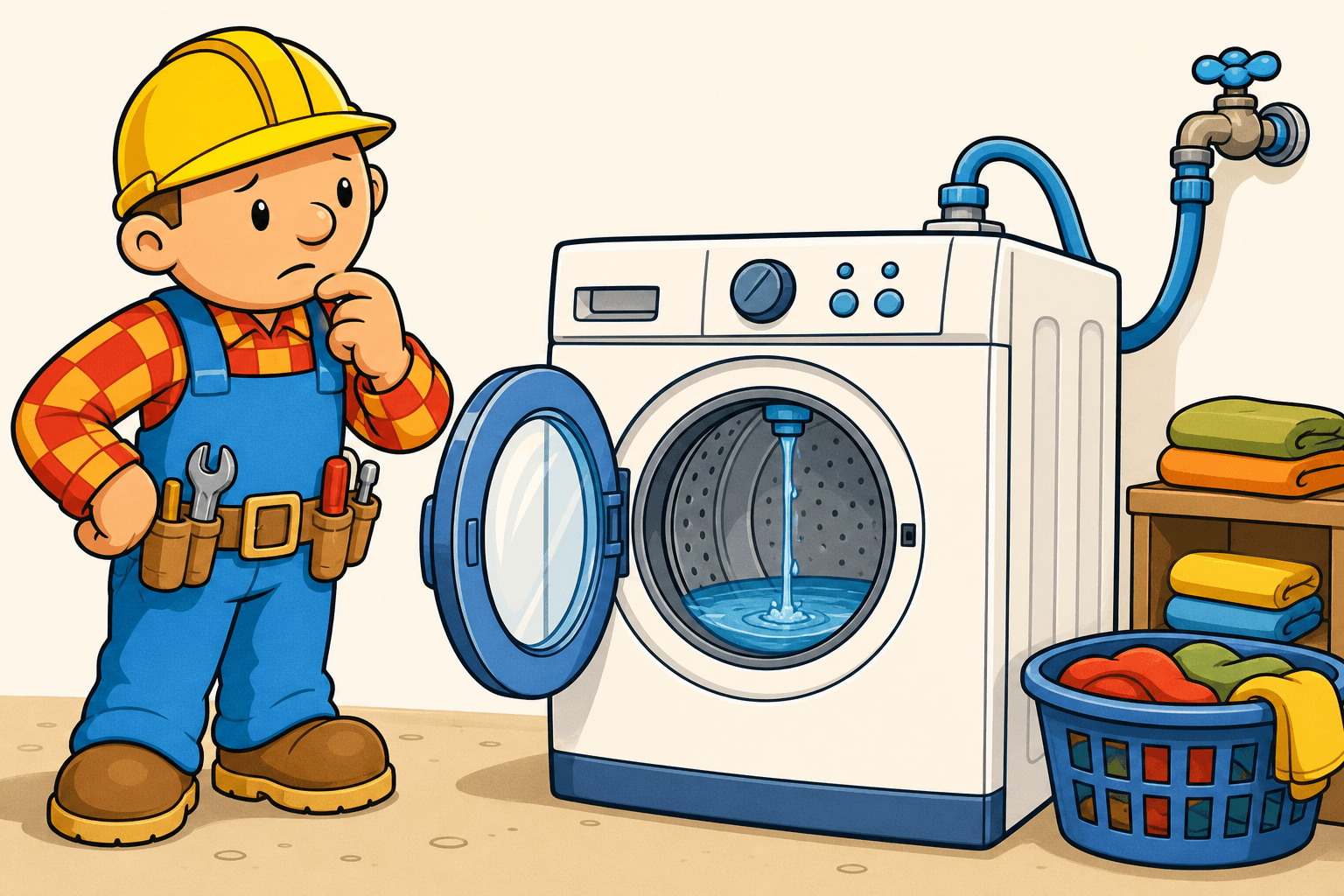
Then answer one question, because it splits the job in half. Clear the code, start a rinse and look into the tub after two minutes. A thin trickle with the level creeping up means water is restricted on the way in. Water running in while the level never rises means the machine is filling and draining at once.
Start With These 30-Second Checks
- 1Before you reach behind the machine: if the code has just appeared, the lid is locked and the pump runs for about eight minutes. Let it finish and unlock, then unplug the washer at the wall, or switch the laundry circuit off at the breaker if the outlet is trapped behind it. None of these checks needs power.
- 2Look behind the washer. Both hoses connected, both faucets fully open? Most Whirlpool washers need hot AND cold connected even on a cold cycle, because the valve reads pressure on both ports.
- 3Run a hand along both hoses and straighten any kink. A hose crushed flat when the machine was pushed back is the most common find of all.
- 4Check where the drain hose enters the standpipe. No more than 4.5 inches (114 mm) should go in, and it must not be taped in.
- 5Open the laundry sink full blast. A weak stream there means your house supply, not the washer, and think back a few days as well: a plumber shutting a valve, street work, or a cold snap reaching a line in an outside wall all show up as this code.
1. A Faucet That Is Not All the Way Open
People skip this one because it feels too obvious, and it still ends more F8 E1 calls than anything else. A valve three quarters open passes plenty of water for a bucket and not enough for a washer working against a fill timer.
- 1Turn both faucets fully open, then back them off a quarter turn so the stem does not seize there.
- 2If a handle spins freely without changing anything, the valve stem has broken inside. That is a plumbing repair.
- 3Confirm both hoses are connected at the wall. A missing hot supply reads as a fill fault on many models even on a cold cycle, the same way a Samsung washer 4C error does.
- 4If your laundry room only has a cold line, shut that faucet and unplug the washer first, then fit a Y-splitter and a second hose so both ports see pressure. Never unscrew a supply connection with the faucet still open.
- 5Push the machine back, take your hands out from behind it, reopen both faucets and check every connection for drips. Only then plug the washer in and restart a rinse, and watch the tub for two minutes before going further.
2. Kinked, Crushed or Clogged Fill Hoses
Rubber fill hoses harden and collapse from the inside with age, and the auto-shutoff type can half-trip and choke the flow without cutting it off. You are hunting a hose that passes water, just not enough.
The hot hose still holds hot water
One of the two supply hoses is the hot line. It and the port behind it hold water at whatever your heater is set to, often 120 to 140 F, for an hour or more after a wash. Shut both faucets, unplug the washer, then run the laundry sink hot until it turns cold before you unscrew anything. Loosen the coupling slowly, point the open end down into the bucket and keep your face and free hand away from it.
- 1Shut both faucets and unplug the washer before you take a hose off. You are about to open a pressurised line behind a live appliance.
- 2Pull the machine forward, put a towel and bucket under the connections, and unscrew each hose at the washer end first.
- 3Hold the hose over the bucket, open end pointed down, and open the faucet slowly. You want a strong steady stream, not a dribble. If this is the hot hose, keep the open end in the bucket and your hand behind the coupling, not over it.
- 4Replace any hose that flows weakly, bulges, or is over five years old. A braided stainless pair costs $15 to $25.
- 5Reconnect hand-tight plus a quarter turn, reopen the faucets, check for drips, then plug the washer back in.
3. Clogged Inlet Screens Behind the Hose Connections
Two fine mesh screens sit in the ports where the hoses screw onto the washer. They catch scale, rust flakes and pipe grit, and after a few years in hard water they pass so little that the fill never finishes.
- 1Shut both faucets and unplug the washer first, then pull it forward so you can reach the two inlet ports.
- 2Unscrew both hoses at the washer end and catch the water in a towel. One of the two is the hot line, so run the laundry sink hot until it turns cold first, then loosen that coupling slowly with the open end pointed down.
- 3Shine a flashlight into each port. White crust is limescale, brown grit is pipe debris, and a screen that looks solid rather than woven is blocked.
- 4Clean each screen in place with an old toothbrush, mild soap and water. Do not pry the screens out with a screwdriver.
- 5Reconnect the hoses hand-tight plus a quarter turn, reopen the faucets and check for drips. Push the machine back and take your hands clear of the connections before you plug it in and run a rinse. A cleared screen shows up as a visibly faster fill.
Do not dig the screens out
On most models the screens are pressed into the valve body and are not sold separately. Tear one out and the whole inlet valve has to be replaced, which turns a free 15-minute clean into a $60 to $150 part.
Let the pump-out finish before you touch the drain hose
After a fill fault most Whirlpool washers lock the lid and pump out for about eight minutes. Pull the drain hose from the standpipe while the drum still holds water and you empty it onto the floor. Wait for the lid to unlock, unplug the machine and check the tub is empty first.
4. The Drain Hose Is Siphoning the Water Back Out
This half of the problem has nothing to do with your supply. A drain hose pushed too deep into the standpipe, or taped in airtight, lets the outgoing water pull a vacuum and drain the tub while the machine is still filling.
- 1Let the pump-out finish and wait for the lid to unlock, roughly eight minutes, then unplug the washer. Do not open the lid or reach in while the drum is still turning or draining.
- 2With the machine unplugged, open the lid and confirm the tub is empty, then pull the washer forward far enough to see where the drain hose enters the standpipe.
- 3Measure how far the hose goes in. More than 4.5 inches (114 mm) and it can siphon.
- 4Pull it back and use the U-shaped plastic form that came with the machine to hold it at the right depth.
- 5Strip off any tape sealing the hose into the pipe. The air gap around it is what breaks the suction.
- 6Measure the standpipe from the floor. Whirlpool asks for at least 39 inches (99 cm). If the machine also struggles to empty, see the Whirlpool washer F21 error guide instead.
5. Low Water Pressure in the House
The inlet valve needs roughly 20 psi to open and hold open. Below that it can click without passing useful water, and the fill times out on a perfectly healthy machine.
- 1Shut both faucets and unplug the washer before disconnecting anything at the back.
- 2With one fill hose off at the washer end and held in a bucket, open the faucet. A gallon jug should fill in well under 30 seconds. Start with the cold hose, because the hot one holds water at heater temperature for an hour or more after a wash.
- 3Screw a pressure gauge onto the laundry faucet. They cost about $12, and under 20 psi means plumbing, not appliance.
- 4Check a whole-house filter or softener. A cartridge left in past its life quietly drops pressure across the house.
- 5To test the washer under load, first reconnect the fill hose hand-tight plus a quarter turn, reopen both faucets, check the connection for drips, take your hands out from behind the machine and plug it back in. Then run a cycle when nothing else in the house draws water. If it fills fine at 6 a.m. and fails while the irrigation runs, the machine is not the problem.
Unplug at the wall before you remove a panel
The power button does not de-energize the control board or the valve solenoids, and both sit within reach once the rear panel is off. Pull the plug, and if the outlet is trapped behind the machine or the washer is hardwired, switch the laundry circuit off at the breaker. Shut both faucets too.
6. A Failed Inlet Valve or Water Level Sensor
If the supply is proven, the screens are clean and the drain hose is set right, the fault has moved inside. Two parts do this: the inlet valve that lets water in, and the water level sensor that tells the board how full the tub is.
- 1Unplug the washer and shut both faucets before you remove a single screw, even if you did it an hour ago for the screens.
- 2Take off the rear access panel, usually a handful of hex screws along the edges.
- 3Find the inlet valve behind the hose connections. Look for scorched or corroded terminals on the two solenoid coils and a cracked body.
- 4Follow the clear hose from the bottom of the tub to the level sensor. Pull it off at the sensor end, blow through it to clear trapped water or detergent sludge, and refit it firmly.
- 5Refit the panel, push the machine back, reopen both faucets, take your hands clear, then plug the machine in and start a rinse. With the water back on, a healthy valve clicks and hums as it opens. If it stays silent, order by the model number under the lid: a valve runs $60 to $150, a level sensor $40 to $80.
Tools You Will Probably Need
🛠️ Tools You Will Need
- •Flashlight - Seeing into the inlet ports and behind the machine
- •Old toothbrush - Cleaning the inlet screens without damaging the mesh
- •Channel-lock pliers - That last quarter turn on the hose couplings
- •Bucket and two towels - Catching the water left in the hoses
- •Water pressure gauge - Settling the 20 psi question, about $12
- •Braided stainless fill hoses - Replacement pair, $15 to $25
When to Call a Pro
If both faucets are open, the hoses flow, the screens are clean, the drain hose sits at the right depth and the house holds 20 psi, and the code still returns, the suspects left are the inlet valve, the level sensor and the control board. The first two are reasonable owner repairs. The third is not.
- 1Under one year old, call Whirlpool service rather than opening anything. A fill fault this early is usually covered.
- 2Over ten years old, get the quote first. A valve plus labour lands around $160 to $350 in many areas, depending on the call-out fee and the part.
- 3Ask the technician to confirm the valve actually failed rather than swapping it on the code alone. A blocked screen reads the same to the board.
- 4Call a plumber instead if your gauge read under 20 psi. That fault is in the wall, not in the washer.
Stuck on a step?
Fixable can analyse a photo of your specific Whirlpool washer and walk you through the exact fix step by step, from the inlet screens to the drain hose depth.
Frequently asked questions
What does it cost to fix a Whirlpool F8 E1 error?
Usually nothing. Opening a faucet, straightening a hose or cleaning the inlet screens costs no parts. Braided fill hoses run $15 to $25 a pair, a water inlet valve $60 to $150, and a service call $100 to $200 before parts. Under a year old, call Whirlpool first, since that fault is usually still covered.
Can I clear F8 E1 myself, or does it need a technician?
Most owners can. The five common causes are faucets, hoses, inlet screens, drain hose depth and house pressure, and none of them means opening the cabinet. Unplug the washer and shut both faucets before touching a hose. Replacing the inlet valve or level sensor is still an owner job on most models, but leave the control board to a technician.
Why does the code come back a few loads later?
Because the restriction was never fully cleared. Scale rebuilds on the inlet screens in hard water within months, and a drain hose that slips back down the standpipe siphons again. If it returns within a week on a machine with good supply, suspect the inlet valve or the water level sensor.
Why is the lid locked and the washer pumping after the error?
That is normal on most Whirlpool washers. After a fill fault the machine locks the lid and runs a pump-out for about eight minutes so it does not sit full. Wait for it to finish and unlock before you move the machine or pull the drain hose out of the standpipe.
STUCK ON YOUR REPAIR?
Paste any video link or just describe the problem. Fixable turns it into a clean step-by-step guide with images, tools, and parts.
Try it free in your browser, no install →3-day free trial · 7 languages · Cancel anytime
Keep Reading
Samsung Refrigerator OF OF Error: Turn Cooling Back On in 60 Seconds
OF OF is not a broken fridge. It is Cooling Off mode, the showroom setting, and it switches the compressor off. Here is the button combination for each Samsung panel and what to do when it will not clear.
LG Dryer D80, D90 and D95: Clear the Vent and Clear the Code
D80, D90 and D95 all say the same thing: lint is choking your dryer's exhaust. The difference is how badly. Here is how to find the blockage, clear it, and stop the code coming back.