Washing Machine Leaking Water? 7 Causes Ranked by How Common
Most washing machine leaks come from the door gasket on front-loaders or a cracked supply hose at the back. Where the puddle sits narrows it down: front means gasket or detergent drawer, back means hoses, underneath means pump or tub seal. A gasket runs $40 to $100 and swaps in about 30 minutes.
In this article
- 01Start With These 30-Second Checks
- 021. Door Gasket Torn or Hardened (Front-Loaders)
- 032. Water Inlet Hose Cracked or Loose
- 043. Drain Hose Loose or Cracked
- 054. Drain Pump Cracked or Loose
- 065. Tub Seal or Bearing Failure
- 076. Detergent Overflow or Drawer Clog
- 087. Washer Not Level (Check This Last)
- 09Tools You Will Probably Need
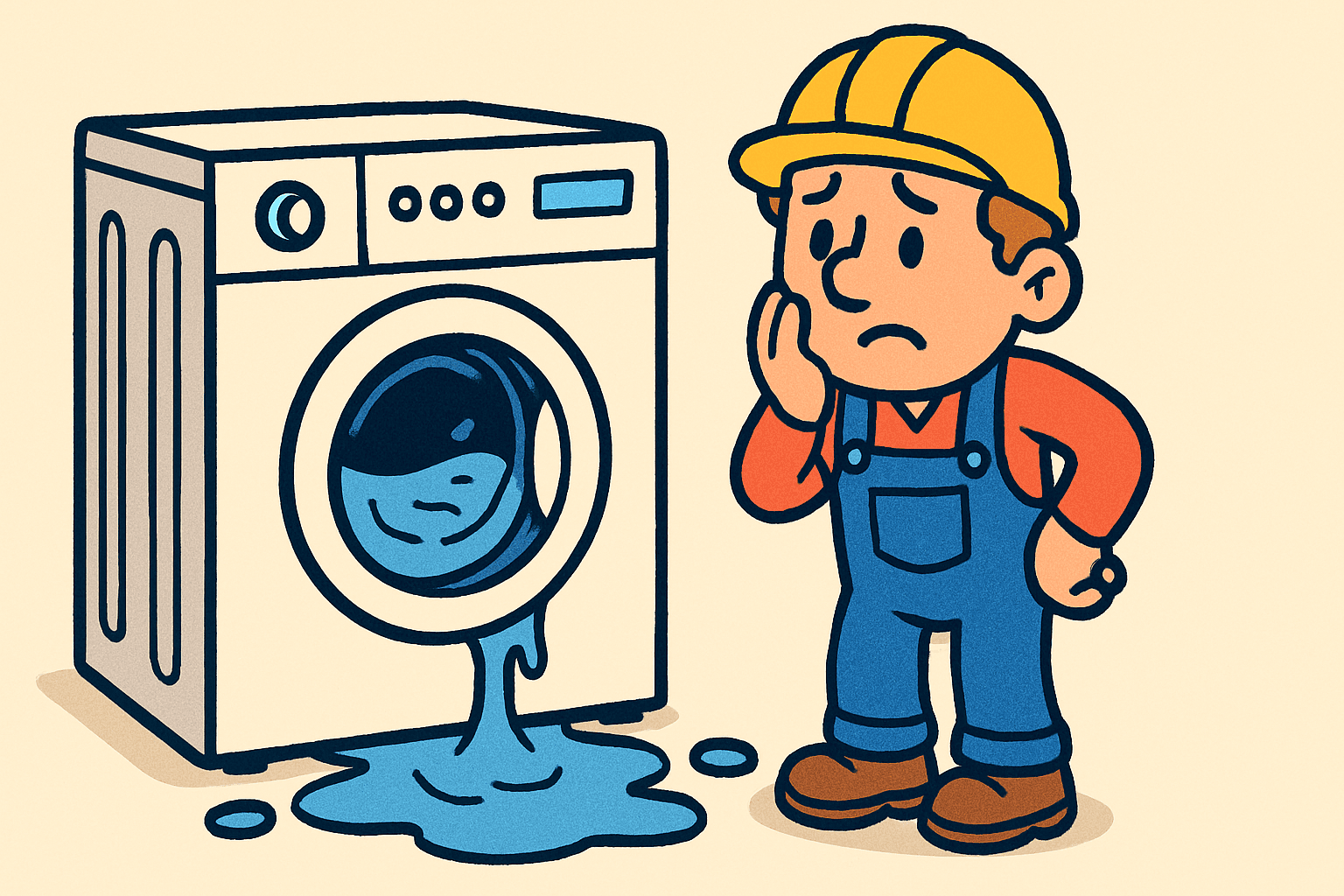
You walk into the laundry room and there is water around the washer. Maybe a small puddle, maybe a small flood. Either way it has to stop before flooring damage piles up. The good news: where the water sits tells you most of what you need to know. Front of the unit means door seal or detergent drawer. Back of the unit means hoses. Under the unit means tub seal or pump.
Before you start checking parts, run an empty cycle and watch the washer from all angles with a flashlight. Catch the leak in the act. Trying to diagnose after the fact rarely works because water spreads.
Start With These 30-Second Checks
- 1Map the leak: front, sides, back, or directly underneath?
- 2Check water hose connections at the wall and at the back of the washer for visible drips.
- 3Inspect the door seal (front-loaders) for tears or trapped debris.
- 4Look at the detergent drawer for old soap buildup that may be diverting water.
1. Door Gasket Torn or Hardened (Front-Loaders)
Number one cause on front-load washers. The rubber boot around the door wears down over time, especially the lower section that sits in standing water. A small tear or a hardened section lets water spray out during heavy spin cycles.
- 1Open the door and inspect the entire gasket - run a fingertip around the inner ring slowly.
- 2Pull back the folds and look for tears, cuts from underwire bras, or hardened brittle sections.
- 3Clean any visible mold or detergent residue with warm soapy water and a soft brush.
- 4If the gasket has any visible tear or hard spot, order the replacement by your model number ($40 to $100 depending on brand).
- 5Replacement involves removing a clamp ring and pulling the old gasket out - takes 30 minutes once you have the new part.
2. Water Inlet Hose Cracked or Loose
Both rubber hoses on the back of the washer are under constant pressure from your house water supply. After 5 to 7 years they crack, swell, or burst. This is the leak that floods entire floors.
- 1Shut off both hot and cold water valves at the wall.
- 2Inspect both hoses for visible bulges, cracks, or rust stains around the fittings.
- 3Disconnect each hose and check the rubber washer inside the fitting - replace any that are cracked or compressed.
- 4If the hose is over 5 years old, replace both with stainless steel braided hoses (about $20 each, last 10+ years).
- 5Hand-tighten new hoses plus a quarter turn with a wrench - over-tightening crushes the washer.
Replace burst hoses immediately
If you find a swollen or visibly cracked inlet hose, do not run another cycle. A burst supply hose can dump 600 gallons per hour into your home. Replace it now or shut the water valves until you can.
3. Drain Hose Loose or Cracked
The drain hose at the back of the washer can wiggle loose where it meets the standpipe or where it connects to the pump. Water sprays out the connection during the drain phase.
- 1Check the connection between the drain hose and the standpipe or sink - it should be secured with a clamp or zip tie.
- 2Pull the washer out and inspect where the drain hose connects to the pump on the back of the unit.
- 3Tighten any loose hose clamps with a Phillips screwdriver (most are spring clamps you can squeeze with pliers).
- 4Replace the hose if it has cracks, kinks that will not straighten, or stiff sections that snap when bent.
4. Drain Pump Cracked or Loose
The pump itself can develop hairline cracks from years of vibration and freeze-thaw cycles in cold garages. The leak shows up directly under the unit, often only during the drain phase.
- 1Unplug the washer and pull it out from the wall.
- 2Remove the access panel and find the pump - it is the part with three hoses (in, out, drum).
- 3Wipe the pump dry, run a short cycle, and watch for water beading on the pump housing.
- 4Tighten any loose mounting screws on the pump.
- 5If the pump body itself is cracked, replace the whole unit - $30 to $80, takes 45 minutes.
5. Tub Seal or Bearing Failure
The tub seal sits between the inner drum and the outer tub. When it fails, water leaks down onto the bearing and the motor. Symptoms: leak under the unit during spin, often with a loud rumbling noise.
- 1Listen during a high-speed spin - a tub seal failure is usually accompanied by a deep rumbling or grinding.
- 2Look under the washer for water with a slight oily or rusty tint (the bearing grease is breaking down).
- 3If your unit is over 8 years old and showing this combination of symptoms, get a repair quote first.
- 4Tub seal replacement requires partial disassembly of the tub - $200 to $400 in labor, often more than the washer is worth.
- 5If the unit is under 5 years old, the warranty may still cover this - check before paying.
6. Detergent Overflow or Drawer Clog
Too much detergent or a clogged drawer can cause water to back up and leak from the front of the unit. This is the easiest leak to fix because it does not involve any hardware failure.
- 1Pull the detergent drawer out fully and look for caked-on soap residue.
- 2Soak the drawer in hot water for 15 minutes and scrub with an old toothbrush.
- 3Look inside the drawer cavity with a flashlight - clean any buildup on the underside of the cavity ceiling.
- 4Use about 2 tablespoons of HE detergent per load (most people use 5 to 10 times too much).
Pro tip
If the leak only happens with certain large items like a comforter or rugs, the unit is overflowing because the load is over the safe weight. The fix is splitting the load, not replacing parts.
7. Washer Not Level (Check This Last)
An unlevel washer rocks during high-speed spin, which can splash water out around the door seal or shake hose connections loose. Always check this even when something else looks like the obvious cause.
- 1Place a small spirit level on top of the washer, both front-to-back and side-to-side.
- 2Adjust the front feet by twisting them - clockwise to raise, counter-clockwise to lower.
- 3Confirm both back feet are sitting flat on the floor, not floating.
- 4Lock any adjustment by tightening the lock nut against the washer body.
Tools You Will Probably Need
🛠️ Tools You Will Need
- •Adjustable wrench - Tightening hose connections at the supply valves
- •Phillips screwdriver - Removing access panels and tightening hose clamps
- •Spirit level - Checking that the washer is sitting level
- •Old towels and a shallow pan - Catching water during inspection and disconnects
- •Stainless steel braided supply hoses - Long-term replacement for old rubber hoses
Not sure where the leak is?
Take a video of your washing machine running and Fixable's AI watches it back, points out exactly where water is coming from, and tells you which part to inspect. Free for 3 days.
Frequently asked questions
How much does it cost to fix a washing machine leak?
Parts are cheap for most causes. A door gasket runs $40 to $100, braided steel supply hoses about $20 each, a drain pump $30 to $80. A failed tub seal is the outlier at $200 to $400 in labor, which on an eight-year-old machine is often more than it is worth.
Can I fix this myself, or do I need a repair tech?
Hoses, clamps, the detergent drawer, leveling feet and the door gasket are all doable with a wrench and a Phillips screwdriver in under an hour. Unplug the machine first. A tub seal or bearing means partial teardown, so get a quote. If water has reached the outlet or wiring, call a licensed electrician.
Will the leak come back after I replace the part?
Usually not, if you replaced the right part. Rubber supply hoses fail again after 5 to 7 years, so braided steel ones lasting 10 or more are the better swap. Gaskets last years but tear early from underwire bras and open zippers. Wipe the lower gasket fold dry once a month.
Is it safe to run another load while it is leaking?
Not if the leak is a swollen or cracked inlet hose. A burst supply hose can dump roughly 600 gallons an hour into the house. Shut both wall valves and leave them off until it is replaced. A slow drip from the drawer or gasket can wait a day or two with a towel down.
STUCK ON YOUR REPAIR?
Paste any video link or just describe the problem. Fixable turns it into a clean step-by-step guide with images, tools, and parts.
Try it free in your browser, no install →3-day free trial · 7 languages · Cancel anytime
Keep Reading
Samsung Refrigerator OF OF Error: Turn Cooling Back On in 60 Seconds
OF OF is not a broken fridge. It is Cooling Off mode, the showroom setting, and it switches the compressor off. Here is the button combination for each Samsung panel and what to do when it will not clear.
LG Dryer D80, D90 and D95: Clear the Vent and Clear the Code
D80, D90 and D95 all say the same thing: lint is choking your dryer's exhaust. The difference is how badly. Here is how to find the blockage, clear it, and stop the code coming back.