Samsung Refrigerator 22E Error: Ice on the Fan, and How to Clear It
Samsung 22E means the fridge compartment's fan is not turning, usually because ice has built up around it. Move all food, freezer contents too, into coolers with ice packs, unplug the fridge and leave the doors open, up to a full day for thick ice, with towels down. Never chip the ice with a knife. If 22E returns within weeks, the defrost system needs a technician.
In this article
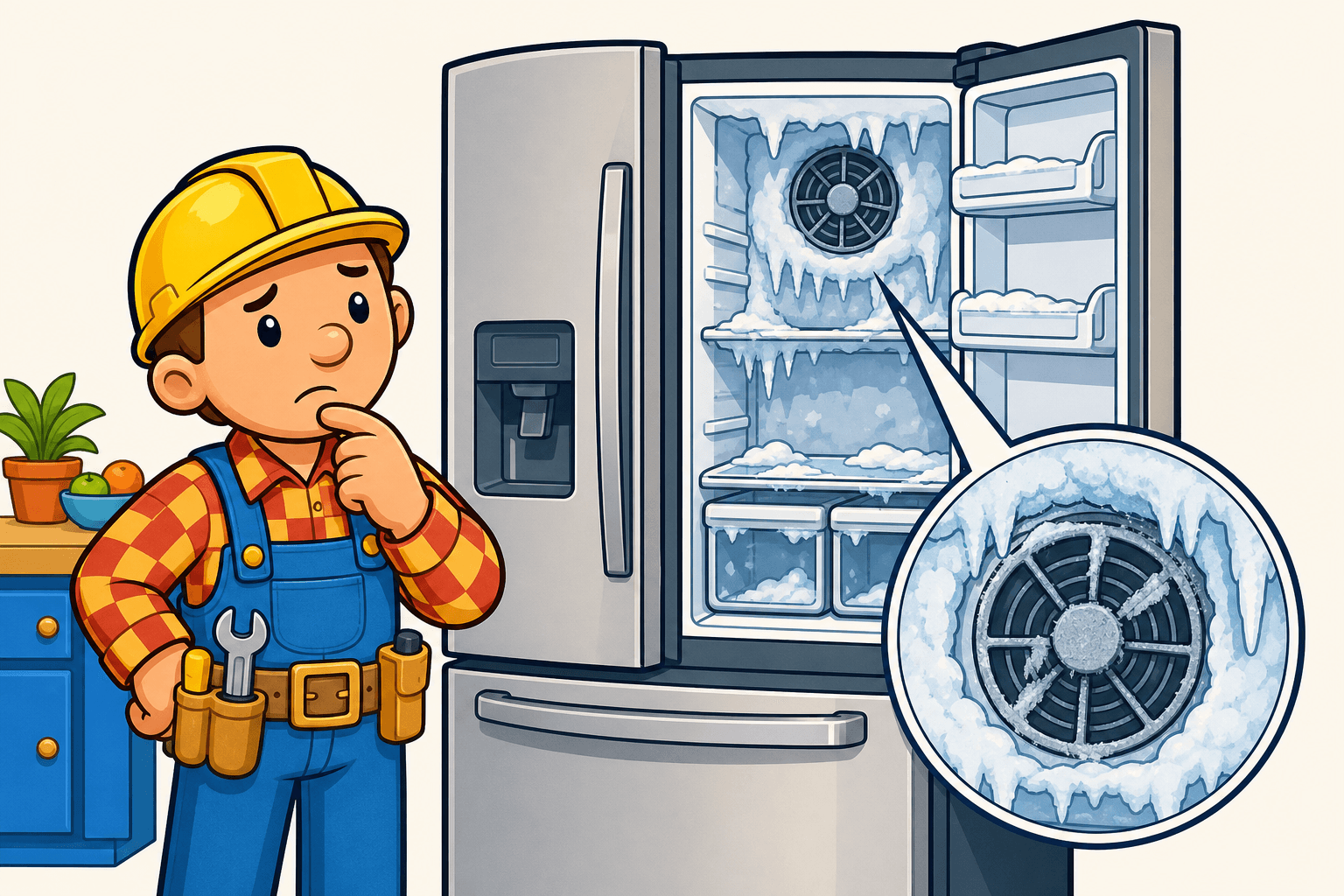
22E usually shows up after a few days of clicking or scraping from the back of the fridge, and food that is not as cold as it should be. The code means the fridge's evaporator fan, the one that blows cold air through the fresh food section, is not turning as it should.
In most cases the fan is fine and ice is holding it: frost builds up behind the rear panel until the blades hit it. The fix is a proper defrost. If there is no ice and the fan still does not turn, the motor may have failed. The freezer has its own fan code, 21E, which is handled the same way. For warm-fridge problems in general, see fridge not cooling.
Start With These 30-Second Checks
- 1Listen at the back of the fresh food section. Clicking or scraping that gets louder over several days is fan blades hitting ice.
- 2Look at the rear wall and the air vents. A white frost patch, or ice around the vents, confirms it.
- 3Check that food is not pushed against the rear vents and that both doors close fully. Warm, moist air getting in feeds the ice.
- 4Put a thermometer in the fridge. Above 40°F (4°C) means food safety matters now, so read the warning below before anything else.
Food first, then power
A closed fridge keeps food safe for about four hours without power, and a proper defrost takes far longer. Move perishables into a cooler with ice or freezer packs before you unplug. Throw away meat, dairy and leftovers that have been above 40°F (4°C) for more than two hours.
1. Do a Full Manual Defrost
This clears most 22E codes. It takes time, not skill.
Never chip or melt the ice with tools
Knives, screwdrivers and ice picks can puncture the evaporator tubing behind the panel, which lets the refrigerant out and usually ends the fridge. Heat guns and hair dryers can warp the plastic liner, and mains power next to meltwater is a shock risk. Let the ice melt on its own.
- 1Move all the food into coolers with ice or freezer packs, the freezer's contents too, because the whole fridge will be off. Check the coolers with a thermometer during the day and top up the ice.
- 2Unplug the refrigerator, or turn off its breaker if you cannot reach the plug.
- 3Leave both doors open and lay thick towels on the floor and in the bottom of the fresh food section to catch the meltwater.
- 4Wait. A light frost melts in a few hours, but ice thick enough to stop the fan sits behind the rear panel where you cannot see it, so allow up to a full day.
- 5Wring out the towels, wipe the compartments dry and close the doors, then plug the fridge back in and give it several hours to cool before you reload the food. If you smell burning or hear buzzing, unplug it again and call a technician.
2. Clear the Vents and Check the Door Seals
Ice builds up faster when warm, humid air keeps getting in. Skip this, and the defrost only buys you a few weeks.
- 1Keep a hand's width of space in front of the air vents on the rear wall; do not push containers against them.
- 2Close each door on a strip of paper and pull it out. If it slides out with no resistance, that stretch of seal is not sealing.
- 3Clean the seals with warm soapy water and dry them. A sticky seal that folds over lets air in.
- 4Make sure nothing on a shelf stops a door from closing fully.
3. Restart the Fridge and Watch the Code
Once the ice is gone, the fan should turn freely again. On most models the 22E code clears by itself after the fridge has been unplugged and restarted.
- 1Plug the fridge back in and listen: you should hear the fan running in the fresh food section soon after the compressor starts. If you smell burning or hear buzzing instead, unplug it again and call a technician.
- 2If the code is still showing, check your manual for how your model clears error codes; the method differs between Samsung ranges.
- 3Give it a full day and check the temperature with a thermometer before you trust it with food again.
- 4Listen for the clicking over the next weeks. It is the earliest sign that the ice is coming back.
🛠️ Tools You Will Need
- •Cooler with ice or freezer packs - Keeps food safe while the fridge defrosts, up to a day.
- •Thick towels - Catch the meltwater in the compartment and on the floor.
- •Fridge thermometer - Tells you when food is at risk and when the fridge is cold again.
- •Strip of paper - Tests the door seals for gaps.
4. When the Ice Keeps Coming Back: the Defrost System
If 22E and the clicking return within days or weeks, the fridge is not defrosting itself as it should. That is a fault in the defrost heater, its sensor or the control board, not in the fan.
- 1Note how long the code stayed away after the manual defrost. Days to a few weeks points to the defrost system.
- 2Look for water pooling under the crisper drawers, a sign that the defrost drain is blocked too. See fridge leaking water.
- 3Book a technician for the defrost heater, sensor or board. They sit behind panels, next to live wiring and the evaporator; a repair typically runs around $150 to $350 with labour.
- 4Until then, a manual defrost each time the clicking starts keeps the fridge usable.
5. When the Fan Motor Itself Has Failed
If there was no ice around the fan and it still does not turn, the motor may have failed.
- 1Leave this to a technician, who unplugs the fridge and removes the rear panel of the fresh food section to reach the fan.
- 2With the fridge unplugged, the technician checks whether the blades turn freely by hand. If they do and the motor still does not run, the motor or its wiring has failed.
- 3A replacement fan motor typically costs roughly $30 to $90; with labour, expect around $150 to $300.
- 4On an older fridge, weigh that repair against its age before you book it.
Pro tip
Clicking from the back of a Samsung fridge is the early warning. Defrosting at the first clicks, before 22E appears, stops the fan blades wearing against the ice.
6. When to Call a Pro
Call a technician if any of these apply.
- 122E comes back within a few weeks of a full manual defrost.
- 2You smell burning or hear buzzing from the back after the defrost. Unplug the fridge and leave it unplugged.
- 3The fridge still does not cool after a full day, even with the fan running.
- 4The fridge is under warranty. A defrost is fine, but opening panels can void it.
Ask your Samsung refrigerator directly
Add your Samsung refrigerator to Fixable: scan the type plate and it finds the operating manual, then answers your questions from it, error codes included. Found a repair video for this? Paste the link and get the steps, tools and parts.
Frequently asked questions
How much does it cost to fix a Samsung 22E error?
Usually nothing, because a full manual defrost, up to a day with the fridge unplugged, clears most 22E codes. If the defrost heater, its sensor or the board has failed, a repair typically costs around $150 to $350 with labour. A new fan motor is roughly $30 to $90 for the part, or around $150 to $300 fitted.
Can I fix 22E myself or do I need a technician?
The defrost is a job for anyone: all food in coolers with ice packs, fridge unplugged, doors open for up to a day, towels down and no tools on the ice. Replacing the fan motor or defrost parts means removing panels near wiring and the evaporator, which for most people is a technician's job.
Why does 22E keep coming back after I defrost the fridge?
A fridge that ices up again within days or weeks is not defrosting itself. The usual causes are a failed defrost heater, its temperature sensor or the control board. Doors that do not seal and blocked vents make it worse. Have the defrost system checked instead of defrosting every week.
Is my food still safe after a 22E error?
Check a thermometer in the fridge. Perishable food that has been above 40°F (4°C) for more than two hours should be thrown away; food that stayed colder is fine. While you defrost, keep everything in a cooler with ice or freezer packs rather than in the warming fridge.
STUCK ON YOUR REPAIR?
Paste any video link or just describe the problem. Fixable turns it into a clean step-by-step guide with images, tools, and parts.
Try it free in your browser, no install →3-day free trial · 7 languages · Cancel anytime
Keep Reading
Bosch Dishwasher E25 Error: Clear the Drain Pump in 20 Minutes
E25 on a Bosch dishwasher usually means something is jammed in the drain pump, often glass, a fruit seed or a label, or that the pump cover is loose. Here is how to fix it safely.
Bosch Washer E17 Error: Why No Water Comes In and How to Fix It
E17 stops a Bosch washer before the wash even starts. It is a water supply code, and the cause is usually at the tap, in the hose or in a tiny filter you can clean in ten minutes.