LG Washer IE Error: 6 Fixes When the Water Will Not Fill
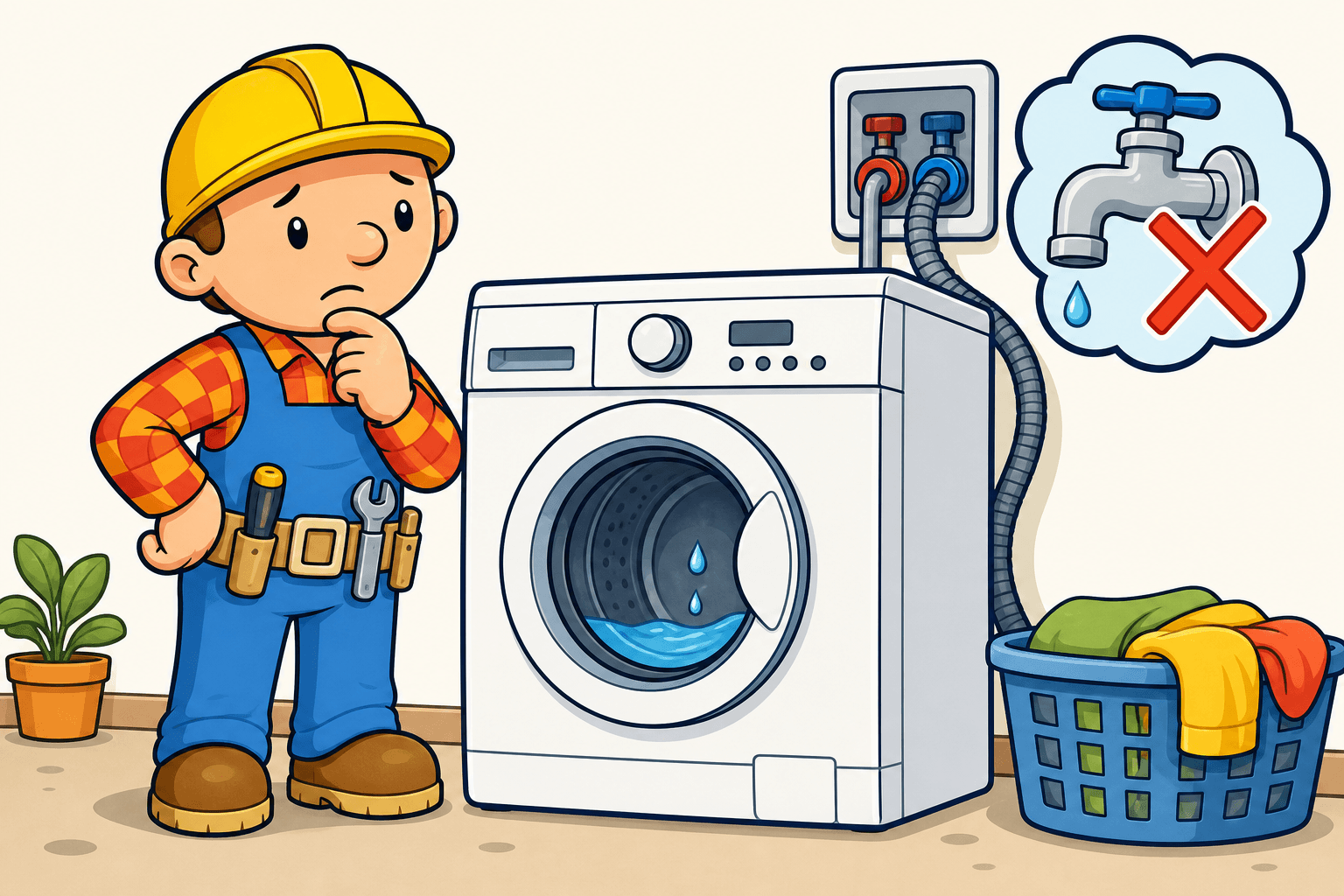
On most LG washers of the last fifteen years, IE (also shown as 1E) means the tub did not fill to its set level in time. Open both taps fully and straighten the fill hoses. Then unplug the washer and close both taps before you unscrew a hose to clean the mesh inlet filters. Free, about half an hour.
In this article
- 01Start With These 30-Second Checks
- 021. A Closed Tap or a Frozen Fill Hose
- 032. Kinked, Crushed or Cross-Connected Hoses
- 043. Clogged Inlet Screens Behind the Hose Connections
- 054. A Drain Hose Pushed Too Far Into the Standpipe
- 065. Household Water Pressure That Is Too Low
- 076. A Failed Inlet Valve, Water Level Sensor or Control Board
- 08Tools You Will Probably Need
- 09When to Call a Pro
Your LG washer takes the load, locks the door, hums for a while and then stops on IE. On almost every LG washer of the last fifteen years, top load and front load alike, IE means inlet error: the tub did not reach its set water level in time. The machine is usually right, and usually innocent. The fault sits between the wall and the back panel.
Three notes first. On many LG displays the capital I is a bare vertical bar, so half the people with this fault search for a 1E error instead. Same code, same fixes. IE is also the opposite of OE: if the machine fills fine but sits full at the end, you want the OE drain error. And resetting an LG washer just means unplugging it for one minute, which clears the display but never the cause.
One question splits this in half. Start a cycle and listen: does any water arrive at all? None points upstream, to the tap, hose, screens or valve. Water that arrives but never rises points at siphoning or weak pressure. Work from the wall inward, where the free fixes live.
Start With These 30-Second Checks
- 1Unplug the washer before you reach behind it. You are working with water next to a 120 V appliance, and every check at the back happens with the plug out.
- 2Both taps turned fully counterclockwise until they stop. Half open fills a bucket fine and still starves the washer's timer.
- 3Both hoses connected, not just the cold one. LG runs hot on the right, cold on the left, the reverse of several brands.
- 4With your hands clear of the machine, plug it back in, start a Rinse and Spin and listen at the back without touching anything. A soft hum with no water means the valve opens and nothing reaches it.
- 5Look in the drum. Bone dry points at supply. A shallow pool that never grows points at the drain hose siphoning it out.
1. A Closed Tap or a Frozen Fill Hose
This is a large share of IE calls, and LG charges for the visit when the technician finds a shut faucet. Anyone who worked on your plumbing, or shut the house off for a trip, may have left a valve closed.
Never thaw a hose with boiling water or a heat gun
LG's limit is water no warmer than 50 C, about 120 F. Boiling water splits the liner inside a braided hose, and an open flame near a plastic fitting turns a slow drip into a flood.
- 1Unplug the washer before you reach behind it. You are handling water beside a 120 V appliance.
- 2Find your main house shutoff before you touch a stiff tap, and stop the moment one weeps at the stem: a seized laundry valve that starts leaking does not stop on its own. Then turn both taps fully counterclockwise until they stop, easing each one closed and open if it will not move. Old valves seize with scale and feel open when barely cracked.
- 3For a frozen line, wrap a towel soaked in hot tap water around the tap and the first foot of hose for five minutes. If a hose is solid, shut both taps, unhook it over a pan and thaw it in warm water.
- 4Open the taps, then plug the washer back in with hands clear and run a rinse cycle to test.
2. Kinked, Crushed or Cross-Connected Hoses
A washer shoved back against the wall crushes its own hoses, and a hose kinked in one spot for years collapses inside where you cannot see it. Cross-connection is the other classic: a cold-only fill on a model expecting both supplies times out on any warm cycle.
Shut both taps before you unscrew anything
The hose at the back of the machine is on the pressurised side. Loosening it with the tap open sends mains pressure water across the room, and on the hot side hot enough to scald. Close both taps, put a pan underneath, and expect about a cup per hose.
- 1Unplug the washer and close both taps before you touch a coupling. The hot hose holds hot water and it will come out.
- 2Lay a towel down and walk the machine forward a few inches at a time, one front corner at a time, so it cannot tip or roll over its own hoses. A front loader weighs 150 to 200 pounds with its counterweights, so get a second pair of hands rather than dragging it.
- 3With the machine standing still, check the full run of both hoses for a kink or a flattened section where it met the wall. A collapsed hose does not recover, replace it.
- 4Confirm hot goes to the hot port and cold to cold, then check the age: rubber at five years, braided stainless at ten, $15 to $30 a pair.
- 5Reconnect hand tight plus a quarter turn, open the taps slowly and watch a full minute for drips from the side, not from over the fitting. Only when the joint stays dry, take your hands out from behind the machine and plug it back in.
3. Clogged Inlet Screens Behind the Hose Connections
This solves most stubborn IE codes, and almost nobody knows the screens exist. Behind each hose connection sits a fine mesh filter catching rust, sand and pipe scale. It takes years to clog and then clogs fast, which is why IE appears out of nowhere.
- 1Unplug the washer and close both taps before anything else in this section. The hot hose still holds house hot water, up to 60 C or 140 F, and it runs out over your hand the moment the coupling comes free.
- 2Put a shallow pan and two towels under the connections, then unscrew both hoses from the machine: break the cold coupling first, and keep your hand above the fitting rather than under it when you loosen the hot one. Expect about a cup of water per hose.
- 3Shine a flashlight into each inlet port, find the small mesh disc just inside the threads, and pull it straight out with needle nose pliers or tweezers. It should come free without force.
- 4Rinse and scrub each screen with an old toothbrush until light passes through the whole mesh. Grey silt and orange rust flakes are what you expect.
- 5Push them back in flush, reconnect hand tight plus a quarter turn, open the taps slowly and check for leaks. With the joints dry and your hands clear of the back of the machine, plug the washer back in.
Test with Rinse and Spin, not a full wash
The fill happens in the first minute of any cycle, so a Rinse and Spin tells you within two minutes whether the fix held. A full wash costs you an hour before the same code returns.
4. A Drain Hose Pushed Too Far Into the Standpipe
If the drain hose sits too deep, the standpipe seals around it and becomes a siphon. Water leaves the tub as fast as it arrives, the level never rises, and the board calls it an inlet fault. LG's limit is 4 inches, about 10 cm, of hose inside the drainpipe.
- 1Unplug the washer, then walk it forward a corner at a time until you can see the standpipe. Do not reach behind or under it until it stands still on all four feet.
- 2Lift the drain hose out and measure from the end how deep it was sitting.
- 3More than 4 inches inside the pipe can produce IE on its own. Reseat it so under 4 inches goes in, leaving an air gap.
- 4Secure it with LG's hose guide or a cable tie so it cannot slide back, and never let the end sit in standing water.
- 5Push the washer back into place, take your hands out from behind it, then plug it in and run a Rinse and Spin to confirm the level rises.
5. Household Water Pressure That Is Too Low
LG specifies at least 14.5 psi of supply pressure and a pressure reducing valve above 116 psi. Below that floor the washer fills, just not fast enough for its own timer, and IE appears with no part faulty. Samsung reports the same condition as a 4C error, so if every fixture is sluggish the washer is only the messenger.
- 1Screw a hose thread pressure gauge onto the laundry tap, $10 to $15, and open it fully. Under 14.5 psi is below LG's minimum.
- 2Replace a whole-house sediment cartridge older than six months. A packed cartridge drops pressure everywhere.
- 3On a well, have the pressure tank cut-in and cut-out settings checked. A waterlogged tank sags during the fill.
- 4Over 116 psi, call a plumber for a pressure reducing valve. High pressure is what bursts fill hoses.
6. A Failed Inlet Valve, Water Level Sensor or Control Board
If the taps are open, the hoses clear, the screens clean and the pressure good, the fault is inside. The inlet valve is a solenoid block where the hoses enter, and its coils burn out. The water level sensor sits on a thin tube and can report a full tub that is not there. A failed board relay looks identical from outside.
Mains voltage lives behind the back panel
This section opens the machine. Unplug it at the wall and close both taps before you remove a single screw, and never take a panel off a washer that is only switched off at the control panel. If you are not comfortable with a multimeter, stop here and book a technician.
- 1Unplug the washer at the wall, close both taps, and wait at least five minutes before you take out a single screw. The main board behind the panel keeps charge in its capacitors after the plug is out, so treat it as live: work around it, do not touch its components or terminals, and never probe it with the washer plugged in.
- 2Find the inlet valve behind the hose connections and check each wire connector is seated. A loose spade terminal is a free fix.
- 3With the washer still unplugged, put a multimeter on ohms across each solenoid coil. An open circuit, meter showing OL, means that coil is dead. A working coil reads in the hundreds to low thousands of ohms on most LG valves, but the figure varies by model.
- 4Trace the thin clear tube to the water level sensor, keeping clear of the control board it runs past, and look for a kink, split or trapped water, then refit every panel before you plug in and reopen the taps.
Tools You Will Probably Need
🛠️ Tools You Will Need
- •Needle nose pliers or tweezers - Pulling the mesh inlet screens out without tearing them
- •Old toothbrush - Scrubbing scale off the screens until light passes through
- •Shallow pan and two towels - Each hose holds about a cup of water
- •Adjustable wrench - Couplings over-tightened at installation
- •Hose thread pressure gauge - Reading real psi against LG's 14.5 psi minimum
- •Multimeter - Only if you reach the inlet valve coils
When to Call a Pro
Everything up to the pressure gauge is homeowner work. Once the panels come off the calculation changes, because telling the valve, the sensor and the board apart takes live voltage testing.
- 1Call if the inlet valve coil tests open and you would rather not fit the part. It runs $30 to $100 and a 30 to 45 minute job.
- 2Call if IE persists with a new valve fitted. That points at the control board relay, worth diagnosing before buying.
- 3Call a plumber, not an appliance technician, if the tap reads under 14.5 psi or over 116 psi. Neither is the washer's fault.
- 4Check the warranty first, and write down what you tested, so the technician does not repeat it on your bill.
Not sure which part you are looking at?
Fixable can analyse a photo of your specific LG washer, name the inlet screen, valve or hose in front of you, and walk you through the exact fix step by step.
Frequently asked questions
How much does it cost to fix an LG washer IE error?
Nothing, in most cases. Opening the taps, cleaning the inlet screens and repositioning the drain hose all cost zero. A pair of braided fill hoses runs $15 to $30, an inlet valve $30 to $100 for the part, and a service call $90 to $150 before parts. Check the warranty first, because opening panels yourself can void it.
Is it safe to work on the back of an LG washer myself?
Yes, for the water side, as long as you unplug the washer and close both taps before you unscrew a hose. The hot hose holds hot water and will spill when you loosen it, so keep a pan and towel underneath. Leave the back panel alone: its control board keeps charge in its capacitors even after you unplug it.
Why does the IE error come back a few loads after I reset the washer?
A power cycle clears the display, not the cause, so IE returns on the next fill if water flow is still short. If it comes back within a load or two, suspect a drain hose that slid back deeper than 4 inches into the standpipe, or a screen refitted with silt still on it. The screens take years to clog.
How do I get my laundry out of an LG washer stuck on IE?
Press Power to end the cycle and wait. A front load door usually unlocks a minute or two after the drum stops. Look through the glass first: if there is water in the drum, run Drain and Spin before you open it, or it lands on the floor. Never force a locked door.
STUCK ON YOUR REPAIR?
Paste any video link or just describe the problem. Fixable turns it into a clean step-by-step guide with images, tools, and parts.
Try it free in your browser, no install →3-day free trial · 7 languages · Cancel anytime
Keep Reading
Samsung Refrigerator OF OF Error: Turn Cooling Back On in 60 Seconds
OF OF is not a broken fridge. It is Cooling Off mode, the showroom setting, and it switches the compressor off. Here is the button combination for each Samsung panel and what to do when it will not clear.
LG Dryer D80, D90 and D95: Clear the Vent and Clear the Code
D80, D90 and D95 all say the same thing: lint is choking your dryer's exhaust. The difference is how badly. Here is how to find the blockage, clear it, and stop the code coming back.