LG Dryer D80, D90 and D95: Clear the Vent and Clear the Code
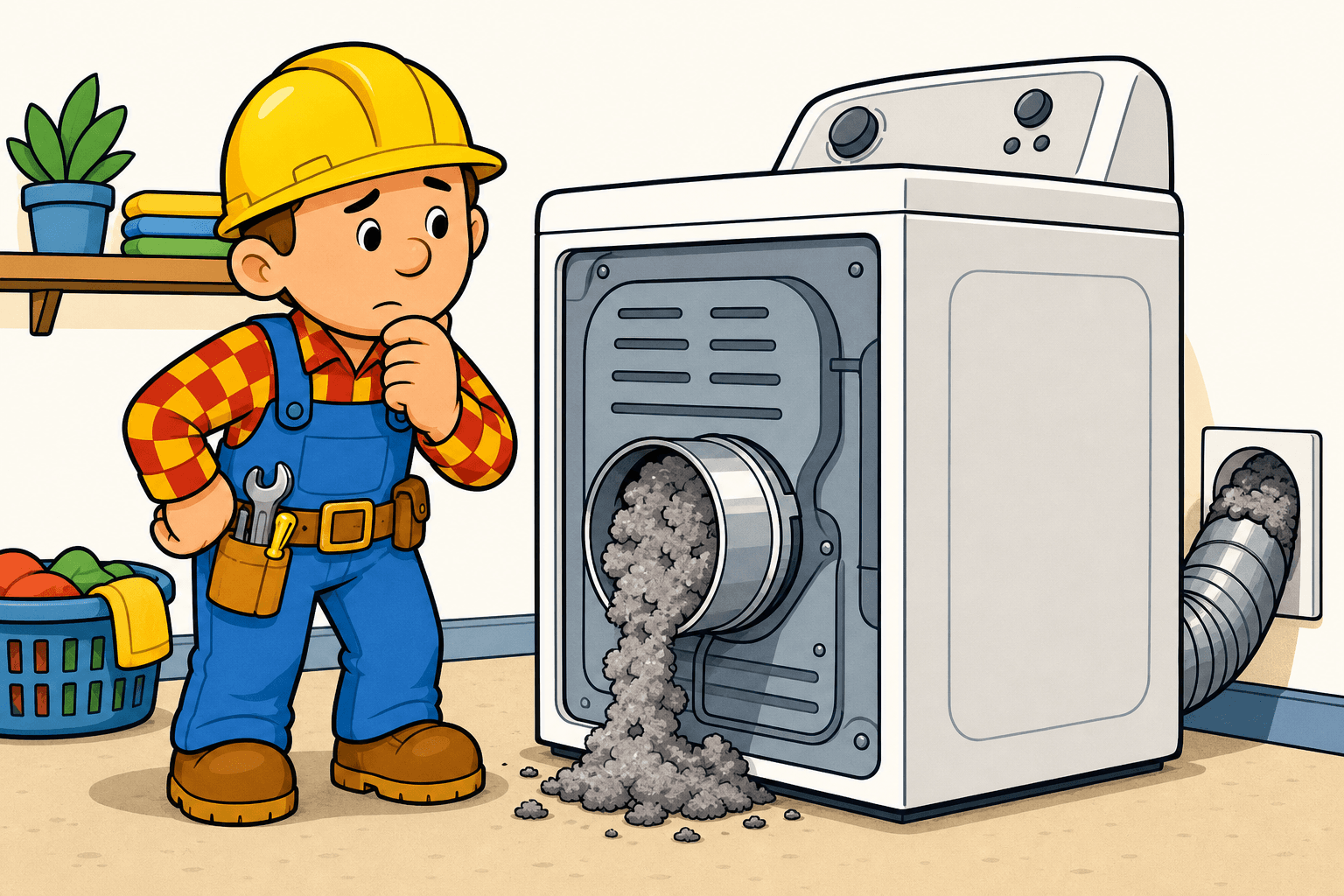
D80, D90 and D95 are LG Flow Sense warnings: on most models the exhaust is roughly 80, 90 or 95 percent blocked. D80 lets the cycle finish, D90 and D95 cut the heat. Unplug the dryer, and on a gas model shut the valve, then clean the lint screen, flexible duct and wall duct. Under an hour of work plus one cycle, no dryer parts.
In this article
- 01Start With These 30-Second Checks
- 02What D80, D90 and D95 Actually Mean
- 031. The Lint Screen Looks Clean but Is Not
- 042. The Flexible Duct Behind the Dryer Is Crushed
- 053. The Wall Duct, the Outside Hood and the Length of the Run
- 064. The Vent Is Clean and the Code Still Shows
- 07How to Clear the Code Once the Vent Is Clean
- 08Tools You Will Probably Need
- 09When to Call a Pro
Your LG dryer ends a cycle with D80 on the display, or quits halfway through with D90 or D95 and the clothes are still damp. Nothing inside is broken. That code is Flow Sense telling you the exhaust is packed with lint.
One question splits this in two. Did the code appear out of nowhere, or has drying been getting slower for months? Out of nowhere means something physical: a duct crushed when the dryer was pushed back, a nest in the hood. A slow slide means ordinary lint buildup, and then the whole run needs cleaning.
Start With These 30-Second Checks
- 1Stop the cycle, then unplug the dryer or switch off its breaker and give it twenty minutes, because the drum and the metal duct stay hot long after a run.
- 2Note which code you got and when. D80 shows after the cycle ends; D90 and D95 stop the dryer mid cycle, so the restriction is worse.
- 3Pull the lint screen and hold it under running water. Water beading on the mesh instead of running through means a softener film is blocking it.
- 4Shine a flashlight behind the dryer, since a flexible duct squashed flat against the wall is the most common cause.
- 5Only if the dryer still runs and nothing smells hot: with your hands clear of the machine, switch the power back on, put the screen back, start a 10 minute timed dry and walk outside. You want a strong warm push of air and an open flapper. If the display showed D90 or D95, or you smell anything hot or burning, skip this test, leave the dryer off and go straight to the duct sections below.
What D80, D90 and D95 Actually Mean
Flow Sense does not measure the duct directly. It watches how fast the exhaust temperature climbs and works backwards to a restriction. On most LG dryers of the last fifteen years, D80 is roughly 80 percent blocked and the dryer keeps running, slowly and hot. D90 is around 90 percent and the dryer cools down and stops heating. D95 is 95 percent or worse and the cycle stops at once.
Those percentages are LG's own calculation and they vary between series. Some models also show D75 or D85, the same warning at a milder level. Treat any of them as one problem: air is not getting out, which is also why loads come out damp. See why your dryer takes forever to dry.
1. The Lint Screen Looks Clean but Is Not
Dryer sheets and liquid softener leave a wax film on the mesh you cannot see, so an empty-looking screen still blocks most of the air.
- 1Turn the dryer off and unplug it, or switch off its breaker if the cord is a heavy 240 volt one, because a hand and a brush are about to go into the machine.
- 2Pull the screen straight up and peel the lint mat off it.
- 3Hold it under warm running water, and if water beads, scrub both sides with dish soap and a soft brush.
- 4Shine a flashlight down the empty slot; grey felt on the walls means the lint duct is loaded, so work a vacuum crevice tool down as far as it goes.
- 5Let the screen dry fully before it goes back, because a damp screen glues fresh lint to itself.
Wash the screen monthly, not yearly
If you use dryer sheets or liquid softener, the water test starts failing again after four to six weeks. A two minute soap wash on the first of the month keeps Flow Sense quiet.
2. The Flexible Duct Behind the Dryer Is Crushed
The four inch duct between the dryer and the wall is the piece that gets crushed. Pushing the machine back folds it flat, and a flat duct passes almost no air.
Gas dryers: deal with the gas line before you pull the machine out
The flexible gas connector behind a gas dryer is not made to be dragged. Shut the gas valve behind the machine before moving it more than a few inches, then move it slowly and straight out. If you smell gas, leave the house and call the gas company from outside.
- 1Unplug the dryer or switch off its breaker, and on a gas model shut the gas valve behind the machine first, as above. If the dryer has just run, give it twenty minutes before you touch anything: the exhaust outlet, the metal duct and the drum stay hot long after the cycle stops.
- 2Walk the dryer straight out, far enough to stand behind it; dragging it sideways is how ducts get crushed. If it is stacked on a washer or sits on a pedestal, do not pull it alone: check that the stacking bracket is still bolted at the back, and get a second person holding the machine before it comes forward.
- 3Loosen the clamp at the dryer outlet and pull the duct off, then do the same at the wall.
- 4Hold the duct up to a light, and if no daylight comes through, shake it out and run a vent brush through it.
- 5Check the material: vinyl or thin foil accordion has to go, only metal is allowed, and the flexible metal portion should stay under eight feet.
- 6Reconnect both ends with clamps and set the dryer back with four to six inches of clearance, so the duct curves instead of folding.
3. The Wall Duct, the Outside Hood and the Length of the Run
This is the part most people skip, and it is where the code comes back from. The run inside the wall can be twenty feet of pipe you never see, and sometimes it is simply too long. Do not answer a long run with larger pipe: air slows in a bigger duct, lint drops out, and the clog rebuilds.
- 1Unplug the dryer or switch off its breaker before anything else, and if it has just run give it twenty minutes to cool. Then pull the flexible duct off the wall fitting, because nothing runs while a brush is inside the pipe.
- 2Feed a rotary vent brush on flexible rods into the wall duct from inside, turning clockwise only, or the rods unscrew and strand a brush head in the wall.
- 3Outside, open the hood cover and pull what is in there out with a gloved hand or the brush head, never a bare hand: expect a felt plug, sometimes a bird nest, sometimes wasps, and the sheet metal edge is sharp. If the hood is above head height, work from a stable ladder with someone footing it, or leave that end to a vent cleaner.
- 4Take off any mesh or screen over the hood, because screens are not permitted on dryer terminations.
- 5Measure the whole path and count the elbows: LG allows 65 feet of four inch duct, minus six feet per 90 degree elbow, and no more than four elbows.
- 6Check the diameter stays four inches and the flapper swings freely, then reconnect the duct and clamp it.
4. The Vent Is Clean and the Code Still Shows
If the whole run is open and D80 comes straight back, the vent is not your problem. Flow Sense reads temperature, so anything that runs the exhaust hot fakes a blockage: a thermistor buried in lint, a hi-limit thermostat opening below its rating, or the control board. The same parts turn up when a dryer will not heat.
Never run a gas dryer with the duct disconnected
The powered test in the list below is for electric dryers only, two minutes, window open. A gas dryer running with its duct off vents combustion gases, carbon monoxide included, into the room. On a gas model skip that test and call a technician.
- 1Unplug the dryer or switch off its breaker, let it cool for twenty minutes, and pull the flexible duct off the back so the outlet is open.
- 2Before you go further: if you are not comfortable running a powered test, opening the cabinet or reading a meter, stop here and book a service call. Everything below means the cabinet comes open.
- 3Electric dryers only: with the duct off and your hands clear of the drum and the open outlet, plug the dryer back in, stand to the side and run a two minute timed dry with a window open. A code with no duct attached means the fault is inside.
- 4Unplug the dryer again, or switch off the breaker, and give it twenty minutes to cool before you touch anything else. The element, the blower housing and the hi-limit thermostat are hot after that test, and the next two steps put your hands on them.
- 5Blow the lint off the outlet thermistor on the blower housing at the back with compressed air, since a lint blanket on that sensor alone can fake a restriction.
- 6With a multimeter, check the thermistor resistance against the wiring diagram inside the dryer and the hi-limit thermostat for continuity at room temperature.
How to Clear the Code Once the Vent Is Clean
Cleaning the duct does not always wipe the display. Flow Sense holds its last reading until the control has seen a clean cycle.
- 1On a gas model, first reopen the gas valve you shut behind the machine, brush a little soapy water on the connector joints and watch for bubbles. If a joint bubbles, or you smell gas at any point, shut the valve, leave the house and call the gas company from outside.
- 2With the duct reconnected, the dryer back in place and your hands clear of the machine, plug it in or switch the breaker on.
- 3If the code is still showing, cut power for five minutes to clear the stored code.
- 4Run one full empty cycle on normal heat, because Flow Sense takes its reading during a real cycle.
- 5Many LG models also have an installation test mode that checks the duct, but the button combination varies by series, so look it up in your owner's manual rather than guessing at the panel.
- 6If the code is gone but drying still needs two cycles, the restriction improved without going away, so go back to the wall duct.
Tools You Will Probably Need
🛠️ Tools You Will Need
- •Rotary dryer vent brush kit, 4 inch - Reaching the full wall duct, where the code comes back from
- •Nut driver or screwdriver - The clamps at both ends of the flexible duct
- •Shop vacuum with a crevice tool - The lint duct under the screen and both duct ends
- •Work gloves - The outside hood: sharp sheet metal, and whatever nested in there
- •Flashlight - Behind the dryer and down the screen slot
- •Flexible metal duct, 4 inch - Replacing vinyl or foil accordion duct, which is not allowed, about $20
When to Call a Pro
Most D80 codes are a Saturday morning and a brush. A few are not.
- 1There is a burning smell during a cycle, or scorch marks on the lint, so stop using the dryer and leave it off until somebody has looked at it.
- 2You smell gas anywhere near a gas dryer: leave the house and call the gas company, not an appliance technician.
- 3The duct exits through the roof, or you cannot reach the middle of the run; vent cleaners average around $145, and $150 to $335 for roof exits.
- 4The code still appears on an electric dryer with the duct fully disconnected, which is an internal fault and a service call of roughly $100 to $200 before parts.
Stuck on a step?
Fixable can read a photo of your specific LG dryer, its duct run or the code on the display, and walk you through the exact fix step by step.
Frequently asked questions
How much does it cost to fix an LG dryer D80 code?
Nothing if the clog is in the lint screen or the flexible duct, though vinyl or foil duct must be swapped for metal, about $20. A vent brush kit runs $20 to $40. Professional vent cleaning averages around $145, more like $150 to $335 for roof exits. A sensor fault means a service call, usually $100 to $200 before parts.
Can I clean an LG dryer vent myself, or do I need someone?
Most people can. Unplug the dryer or switch off its breaker, and on a gas model shut the gas valve first, then pull it out, undo the duct clamp and run a vent brush through. Rod kits reach 12 to 25 feet, so call someone for a longer run, a roof exit, or a hood you cannot reach safely.
How often does the D80 code come back after cleaning?
If you cleaned the whole run, most homes go one to two years before it returns. It comes back within weeks when only the flexible duct was cleaned and the wall duct was not, when the duct is vinyl or foil, or when a screen sits over the outside hood.
Is it safe to keep running an LG dryer that shows D80?
Not for long. D80 means airflow is badly restricted, and failure to clean is the leading cause of dryer fires, about a third of the roughly 13,000 US dryer fires a year. Stop the cycle now if you smell burning or see scorch marks on the lint. Otherwise finish the load, then clean the vent before the next one.
STUCK ON YOUR REPAIR?
Paste any video link or just describe the problem. Fixable turns it into a clean step-by-step guide with images, tools, and parts.
Try it free in your browser, no install →3-day free trial · 7 languages · Cancel anytime
Keep Reading
Samsung Refrigerator OF OF Error: Turn Cooling Back On in 60 Seconds
OF OF is not a broken fridge. It is Cooling Off mode, the showroom setting, and it switches the compressor off. Here is the button combination for each Samsung panel and what to do when it will not clear.
Bosch Dishwasher E22 Error: Clean the Filter, Clear the Code
E22 is the friendliest code Bosch shows: on most models it just means the filter is blocked and water is sitting in the sump. Twist the filter out, rinse it, put it back. No screwdriver, no parts.