Freezer Too Cold and Frosting Up? 4 Causes and Fixes
A freezer that overfreezes is usually running on a temperature setting pushed too low or a stuck cold control, so the compressor never shuts off. Set it back to 0 degrees Fahrenheit and wait 24 hours. That costs nothing. A replacement cold control runs about $20 to $60 and takes under an hour.
In this article
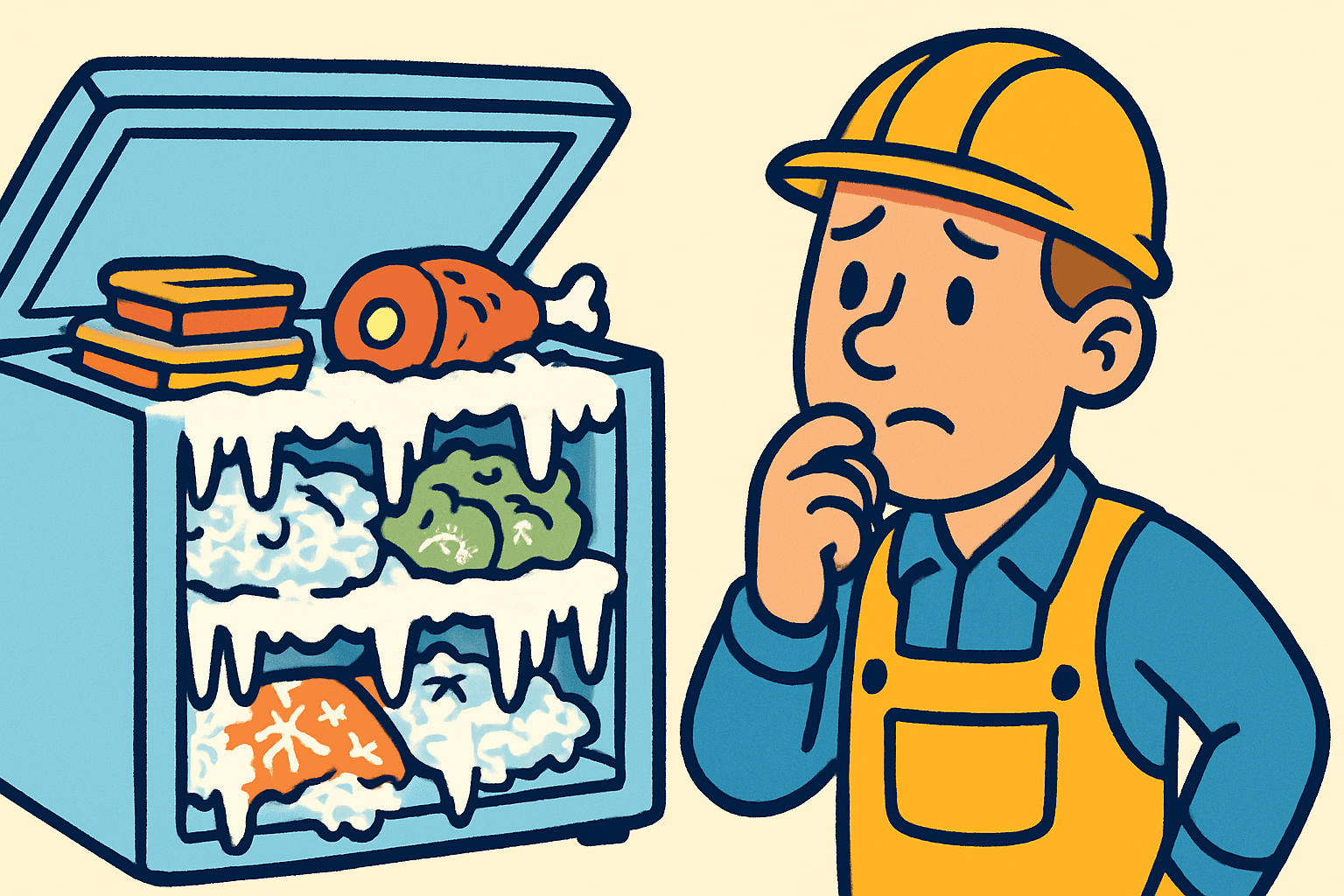
A freezer that overfreezes food and grows a coat of frost is not a lucky over-performer. It is running longer than it should, which drives up your power bill and buries the coils in ice. The good news is that the four causes are all cheap parts or free adjustments, and this guide takes them in the order to check.
Look at where the frost forms, because it splits the problem in half. Frost on the back inside wall points to the defrost system. Frost around the door and top edges points to a seal letting in humid room air. That single clue tells you which two causes below to read first.
Start With These 30-Second Checks
- 1Check the temperature setting. A dial bumped to max or a digital setpoint below minus 5 degrees will overfreeze.
- 2Put a thermometer inside and read it after two hours. A freezer should sit near 0 degrees, not minus 10 or colder.
- 3Note where the frost forms: the back wall points to defrost, the door edges point to a seal.
- 4Make sure interior vents are not blocked by packed food, which traps cold air in one spot.
1. Thermostat or Temperature Setting Stuck
The most common reason a freezer runs too cold is the temperature control itself, either set wrong or failing. A mechanical cold control can stick closed and never shut the compressor off.
- 1Turn the setting to the middle of its range and wait 24 hours.
- 2If it is a dial, listen for the compressor to click off as you turn it to the warmest setting. No click can mean a stuck control.
- 3On digital models, unplug for five minutes to reset the board, then set 0 degrees.
- 4If the freezer still runs nonstop, test the cold control for continuity in the off position. A control that never opens needs replacing.
- 5Fit the model-specific thermostat. It is an inexpensive plug-in swap.
2. Faulty Air Damper
In fridges where one set of coils cools both compartments, a damper controls how much cold air the fridge side gets. If the damper sticks open the freezer dumps too much cold, and if it sticks shut the fridge warms while the freezer overfreezes.
- 1Find the damper control, usually behind a panel in the fresh food section near the top.
- 2Watch whether the flap moves when you change the fridge setting.
- 3Clear any ice or food debris jamming the flap.
- 4If the flap is cracked or the motorized damper does not move, replace the assembly.
- 5Give the system a day to rebalance both compartments.
3. Worn Door Gasket Letting in Humid Air
A worn or dirty door gasket lets warm humid room air seep in. The freezer answers by running longer and colder, and that humidity freezes into the frost you see near the door.
- 1Close the door on a dollar bill and tug. If it slides out with no resistance, the seal is weak there.
- 2Wipe the gasket with warm soapy water to remove grime that stops it sealing.
- 3Warm a stiff, folded gasket with a hair dryer and press it back into shape.
- 4Smear a thin film of petroleum jelly on the sealing face to help it grip.
- 5Replace a torn or permanently deformed gasket with the model-specific part.
Do not force a frost-jammed door
If frost has sealed the door shut, unplug the unit and let it thaw. Prying it open can tear the gasket and warp the door liner.
🛠️ Tools You Will Need
- •Freezer thermometer - Confirms whether the freezer is genuinely too cold or just feels that way
- •Multimeter - Tests the cold control and defrost thermostat for continuity
- •Hair dryer - Reshapes a stiff door gasket and speeds a manual defrost
- •Nut driver set - Removes the rear evaporator cover to reach the defrost heater
4. Failed Defrost System Icing the Coils
Every frost-free freezer melts coil frost a few times a day. When the defrost heater, thermostat, or timer fails, frost snowballs on the coils, chokes airflow, and the compartment swings between icy near the coils and frosty everywhere else.
- 1Unplug the freezer, empty it, and remove the rear inside panel to expose the coils.
- 2Coils buried in a solid block of frost confirm a defrost failure.
- 3Melt all the frost fully with the unit unplugged and a towel to catch water.
- 4With a multimeter, test the defrost heater and defrost thermostat for continuity. An open reading on either points to the failed part.
- 5Replace the failed component, or the control board if the timer is board-driven, then reassemble.
- 6Run the freezer empty for a day and confirm frost does not return.
Pro tip
Before ordering parts, do a full 24-hour manual defrost with the unit unplugged and doors open. If the freezer behaves for a week and then frosts up again, you have confirmed a defrost-system fault rather than a one-time ice build-up.
Fix your freezer with AI
Describe what your freezer is doing and Fixable's AI finds the cause and gives you every step. Or scan its type plate: Fixable finds the operating manual and answers from it, error codes included. Found a repair video for this? Paste the link and get the steps, tools and parts.
Frequently asked questions
How much does it cost to fix a freezer that freezes everything?
Parts are cheap. A cold control or defrost thermostat runs about $15 to $60, a defrost heater $25 to $70, and a model-specific door gasket $50 to $150. A service call is usually $100 to $200 before parts, so most of these are worth trying yourself first.
Can I replace the defrost heater myself, or do I need a technician?
Most people can. Unplug the freezer, take the rear inside panel off with a nut driver, and swap the heater or thermostat in about two hours. If frost returns with new parts, or you see an oily film near the coils, call a licensed refrigeration technician. Sealed refrigerant systems are pro work.
Will the frost come back after I defrost it by hand?
A manual defrost clears the ice, not the cause. If the frost came from a door left ajar, it usually stays clear. If a solid coat is back on the rear wall within one to two weeks, the defrost heater or thermostat has failed, and the ice will keep returning until that part is replaced.
Where do I put the food during a 24-hour defrost?
Move it to a cooler packed with ice packs. A full cooler holds frozen food for roughly 24 hours, one that is only half full for about 12. Anything that thaws and sits above 40 degrees Fahrenheit for more than two hours should be thrown out rather than refrozen.
STILL STUCK?
Describe what's broken and Fixable's AI finds the cause and gives you every step. Found a repair video? Paste the link. Or scan the type plate and Fixable answers from the manual, with the page.
Open it in your browser, free to try →Free trial · 6 languages · Cancel anytime
Keep Reading
Bosch Dishwasher E25 Error: Clear the Drain Pump in 20 Minutes
E25 on a Bosch dishwasher usually means something is jammed in the drain pump, often glass, a fruit seed or a label, or that the pump cover is loose. Here is how to fix it safely.
Bosch Washer E17 Error: Why No Water Comes In and How to Fix It
E17 stops a Bosch washer before the wash even starts. It is a water supply code, and the cause is usually at the tap, in the hose or in a tiny filter you can clean in ten minutes.