Bosch Dishwasher E15 Error: How to Fix It in 5 Minutes
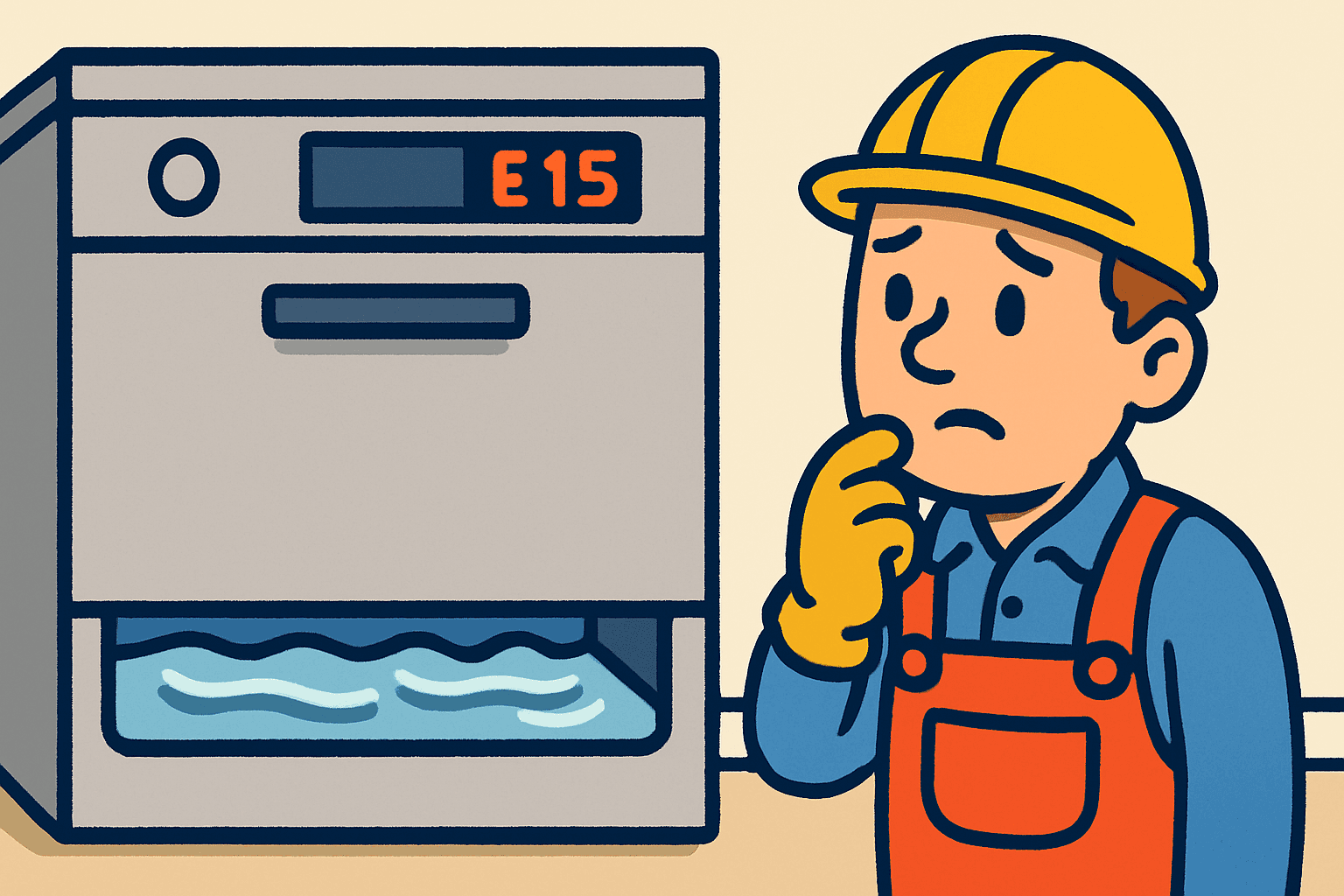
E15 means water has collected in the base pan and tripped the Aquastop float switch. Cut power at the breaker, tilt the dishwasher back 30 to 45 degrees for 60 seconds so the pan drains, then restore power and start a cycle. That is the reset: about five minutes on most units, at no cost, and no button does it for you.
In this article
- 01Start With These 30-Second Checks
- 02How to Reset a Bosch E15 Error (the Tilt Is the Reset)
- 031. Tilt the Dishwasher to Drain the Pan
- 042. Find the Source of the Leak
- 053. Replace the Door Seal If It Is Cracked or Pinched
- 064. Tighten or Replace the Water Inlet Hose
- 075. Check the Salt and Rinse Aid Caps
- 086. When to Call a Pro
- 09Tools You Will Probably Need
Your Bosch dishwasher is flashing E15 (sometimes called E:15 or just E15) and refuses to start a new cycle. There is no visible flood in your kitchen, no obvious leak, but the unit is locked. This is one of Bosch's most common error codes and almost always has the same cause: a tiny amount of water reached the base pan and tripped the Aquastop float switch.
Before doing anything else, look at the floor under and in front of the dishwasher. If you see standing water, you have an active leak and the order matters: stop the leak first, then clear the error. If the floor is dry, the water in the pan is likely from a small splash or condensation, and the fix below clears it in five minutes.
Start With These 30-Second Checks
- 1Look at the floor in front of and under the dishwasher with a flashlight. Wet means active leak.
- 2Open the door and check whether the bottom of the tub is wet - dripping from above the tub is different from water in the base pan below it.
- 3Confirm the model has Aquastop (most Bosch dishwashers from 2010 onward do) - if not, E15 may have a different meaning, check the user manual.
- 4Make sure no recent activity could have caused a splash: dishwasher pod broke open, salt cap left loose, kitchen flood reaching the dishwasher feet.
How to Reset a Bosch E15 Error (the Tilt Is the Reset)
There is no hidden reset button for E15. The code clears itself the moment the float switch in the base pan drops back down, and the only way to make that happen is to get the water out from under the machine. Holding Start for three seconds cancels a cycle but does not clear E15 while the pan is still wet. This is the whole procedure:
- 1Switch the dishwasher off at the breaker, not only at the door panel. On many installs the Aquastop hose is hardwired into a junction box under the sink, and you are about to move the machine.
- 2Open the door and remove the two screws that fix the frame to the countertop or side cabinets, then lay a towel in front of the unit.
- 3With a second person, tilt the dishwasher backwards 30 to 45 degrees and hold it for about 60 seconds. You will usually hear water run out of the base pan onto the floor behind it.
- 4Set it back down, dry the floor, restore power at the breaker and press On. If the pan is dry the display shows a normal cycle instead of E15.
- 5Start a short rinse cycle and watch the display for the first two minutes. If E15 returns straight away, the pan is filling again and one of the leaks in the sections below is still open.
Unplugging alone does not reset it
Cutting power for 10 minutes without tilting almost never clears E15. The float switch is mechanical: as long as the pan holds water, the code comes straight back when power returns.
1. Tilt the Dishwasher to Drain the Pan
This is the fix that works on 8 out of 10 E15 calls. The base pan holds maybe a cup of water. Tipping the unit lets that water drain out the back, the float drops, and the Aquastop resets.
- 1Turn the dishwasher off at the breaker - do not just unplug it because the Aquastop is hot-wired in many installs.
- 2Lay an old towel on the floor in front of the unit.
- 3Carefully tilt the dishwasher backward about 30 to 45 degrees - have someone help on units with hidden leg adjusters.
- 4Hold for 60 seconds. You may hear a soft trickle as water drains out the rear of the base.
- 5Lower the unit back down, restore power at the breaker, and start a fresh cycle. The E15 should clear within 30 seconds of the cycle starting.
Why not just unplug it?
On many Bosch installs the Aquastop solenoid is wired to a hardwired junction box, not a regular outlet. Cutting power at the breaker is the only way to fully de-energize the unit before tilting it.
2. Find the Source of the Leak
If the E15 returns within a few cycles, water is still reaching the pan. You need to find where it is coming from before another tilt will help.
- 1Pull the dishwasher out from under the counter (carefully - the water and power lines are still connected).
- 2Run a short cycle and watch the bottom edges, the water inlet hose, and the drain hose for any drip.
- 3Open the door mid-cycle and check the door gasket for a torn or pinched section - look for water on the outer door panel.
- 4Inspect the salt cap and rinse aid cap for proper sealing - a loose cap drips inside the door over time.
- 5Run your hand along the underside of the tub looking for moisture - a hairline crack from years of heat cycling sometimes leaks only when full.
3. Replace the Door Seal If It Is Cracked or Pinched
The door gasket is rubber, and rubber dies after 8 to 10 years. A bad gasket lets water spray out during heavy cycles, which trickles down the front and pools under the unit.
- 1Open the door and look at the entire gasket - run a fingertip along it.
- 2Check for tears, hardened sections, gaps where it meets the corner, or food residue baked into a fold.
- 3Clean it first with warm soapy water and a soft brush. A dirty gasket can fail to seal even when intact.
- 4If it is hard, brittle, or torn, order the replacement by your model number from the Bosch parts site (around $40 for most models).
- 5Replacement just pulls out and snaps in, no tools needed, takes 5 minutes.
4. Tighten or Replace the Water Inlet Hose
Bosch dishwashers use an Aquastop hose with a built-in solenoid valve. If the connection at the wall or the unit loosens over time, water drips during fill and runs down to the pan.
- 1Shut off the water supply valve under the sink (the small valve on the hot water line going to the dishwasher).
- 2Disconnect the inlet hose from the wall valve and from the unit.
- 3Inspect both ends for cracks in the rubber washers or visible mineral buildup.
- 4Replace the rubber washers (about 50 cents each at any hardware store) before reconnecting.
- 5Hand-tighten plus a quarter turn with a wrench - over-tightening crushes the washer and creates a slow leak.
5. Check the Salt and Rinse Aid Caps
European-style Bosch units have a salt reservoir in the base of the tub. If the salt cap is not screwed down fully, water leaks into the salt compartment, then into the base pan.
- 1Pull out the lower rack and find the salt cap (large round cap, usually green or blue, in the floor of the tub).
- 2Unscrew it fully - the seal is an O-ring inside the cap.
- 3Check the O-ring for cracks or food debris.
- 4Replace the O-ring if damaged - any appliance parts site sells the matching one for under $5.
- 5Fill the salt reservoir if empty (use only dishwasher salt, never table salt), then screw the cap back hand-tight plus a small turn.
Pro tip
After any tilt or hose work, run an empty short cycle on the highest temperature setting first. This stress-tests the seals and surfaces any small leak early, before you trust the unit with a real load.
6. When to Call a Pro
If you have tilted the unit, replaced the gasket, checked all hoses, and E15 still returns, the issue is deeper - usually a stress crack in the inner tub liner, a failed Aquastop solenoid, or a control board that no longer reads the float correctly. These need a qualified Bosch tech.
- 1If your unit is under 5 years old, schedule a Bosch warranty service call - some E15 cases were covered under extended programs.
- 2If over 10 years old, the repair often costs more than a new entry-level unit. Get a quote first.
- 3Ask the tech specifically whether the float switch tested ok - that is the part most often replaced unnecessarily.
- 4Document the error history (date, what you tried, when it returned) so the tech does not start from scratch.
Tools You Will Probably Need
🛠️ Tools You Will Need
- •Adjustable wrench - Loosening and tightening the inlet hose connections
- •Old towel or two - Catching water during the tilt and any disconnect
- •Flashlight - Inspecting the floor and the underside of the tub
- •Replacement rubber washers - Cheap insurance when reconnecting the inlet hose
- •Bosch door gasket (your model) - If the existing gasket is torn or hardened
Need help identifying parts?
Take a photo of your Bosch dishwasher's salt cap, gasket, or hose and Fixable's AI tells you exactly which part you are looking at and how to inspect it. Free for 3 days.
Frequently asked questions
What does it cost to fix an E15 error?
The tilt costs nothing. If something is actually leaking, parts are cheap: rubber washers for the inlet hose run about 50 cents, a salt cap O-ring under $5, a door gasket around $40. A technician visit is usually $100 to $200 before parts, so try the tilt first.
Is tilting the dishwasher safe to do on my own?
Yes, with two people. Switch off the breaker first, not just the plug, because the Aquastop is hardwired into a junction box on many installs. Tilt it back 30 to 45 degrees and hold for 60 seconds. If the wiring or junction box looks damaged, stop and call a licensed electrician.
Will the E15 come back after I tilt it?
Often not. If the water was a one-time splash from a burst pod or a loose salt cap, the tilt is the whole repair. If E15 returns within a few cycles, something is still leaking: check the door gasket first, since the rubber usually hardens after 8 to 10 years.
How do I reset a Bosch dishwasher after an E15 error?
Tilt it. Cut power at the breaker, tilt the machine back 30 to 45 degrees for about 60 seconds so the base pan drains, then restore power and start a cycle. There is no reset button for E15 and unplugging alone rarely clears it, because the float switch stays up until the pan is dry.
STUCK ON YOUR REPAIR?
Paste any video link or just describe the problem. Fixable turns it into a clean step-by-step guide with images, tools, and parts.
Try it free in your browser, no install →3-day free trial · 7 languages · Cancel anytime
Keep Reading
Samsung Refrigerator OF OF Error: Turn Cooling Back On in 60 Seconds
OF OF is not a broken fridge. It is Cooling Off mode, the showroom setting, and it switches the compressor off. Here is the button combination for each Samsung panel and what to do when it will not clear.
LG Dryer D80, D90 and D95: Clear the Vent and Clear the Code
D80, D90 and D95 all say the same thing: lint is choking your dryer's exhaust. The difference is how badly. Here is how to find the blockage, clear it, and stop the code coming back.